RAG Development Services
InterCode builds production-grade retrieval-augmented generation systems that give AI models accurate, grounded answers from your data. We design end-to-end RAG pipelines — from document ingestion and vector indexing to hybrid search, re-ranking, and evaluation — that reduce hallucinations and keep AI responses current and trustworthy.
Grounded AI That Knows Your Data
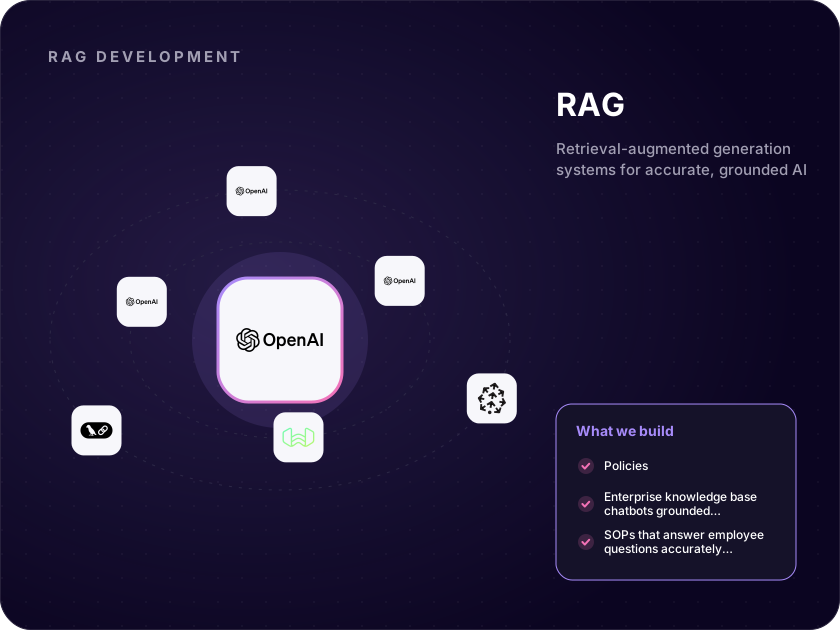
RAG (Retrieval-Augmented Generation) solves the most critical problem with LLMs in enterprise settings: hallucination. By retrieving relevant documents at query time and providing them as context, RAG grounds model responses in verified information without expensive fine-tuning. At InterCode, RAG is our primary architecture for knowledge-intensive AI applications.
A well-designed RAG system is significantly more complex than connecting an LLM to a vector database. Document ingestion strategy — how you split, clean, and enrich text — has the largest impact on retrieval quality. We design chunking strategies tailored to each document type: recursive splitting for prose, table-aware extraction for PDFs, and semantic chunking for technical documentation. Embedding model selection (OpenAI, Cohere, BGE, or domain-specific models) is matched to your document vocabulary.
Hybrid search — combining dense vector similarity with BM25 keyword search — consistently outperforms pure vector search by catching exact terminology that semantic search misses. We add cross-encoder re-ranking to push the most relevant chunks to the top of the context window. For evaluation, we implement RAGAS metrics (faithfulness, answer relevancy, context recall) and run regression tests on a golden question set before every deployment. The result is a RAG system whose accuracy you can measure and improve continuously.
Why We Use RAG (Retrieval-Augmented Generation)
This technology is part of our AI and machine learning toolkit for building intelligent systems. We select AI tools based on model quality, inference performance, integration complexity, and whether they can be deployed in the environments our clients require — cloud, on-premise, or edge.
RAG Systems We Build
We build enterprise knowledge base chatbots grounded in internal documentation, policies, and SOPs that answer employee questions accurately without hallucination. Legal document analysis systems that retrieve and synthesize information from thousands of contracts and regulations are a strong fit for RAG. Product support bots that give precise, citation-backed answers from technical documentation reduce support ticket volume by 40-60%.
Research assistants that surface relevant passages with citations from scientific literature, and hybrid RAG systems that query both vector stores and structured SQL databases, are among our most technically sophisticated deliveries.
Related Services
AI integration
Add AI capabilities to your existing software without a big-bang rewrite. InterCode provides ai integration services — embedding LLMs, AI agents, and intelligent automation into your SaaS platform, internal tools, or enterprise systems.
Learn moreGenerative AI Development for Production
Move beyond prototypes with production-grade generative AI solutions. InterCode builds LLM-powered applications with retrieval-augmented generation, fine-tuned models, and robust guardrails that deliver reliable, accurate results in real business environments.
Learn moreData Engineering for Smarter Decisions
Your data is only as valuable as the infrastructure that moves and transforms it. InterCode builds reliable data pipelines, warehouses, and streaming architectures that turn raw data into the insights your business depends on.
Learn moreCustom AI
Build production-ready AI applications, LLM systems, and autonomous AI agents with InterCode. We are a specialist ai software development agency that has shipped 50+ AI products — from prototypes to enterprise-scale platforms.
Learn moreRelated Technologies










Frequently Asked Questions
Retrieval-Augmented Generation (RAG) is a technique where relevant documents are retrieved from a knowledge base and provided to an LLM as context before it generates a response. This grounds the AI's answers in verified sources, dramatically reduces hallucinations, and allows the model to answer questions about information it was never trained on — including your internal documents, recent news, and proprietary data.
RAG is better when your knowledge base changes frequently, when you need citations and source traceability, when data privacy prevents sharing documents with model providers, or when the cost of fine-tuning is not justified. Fine-tuning is better for changing the model's reasoning style, tone, or format, or when you need the model to internalize deep domain expertise that cannot easily be retrieved. For most enterprise knowledge applications, RAG is the right starting point.
Well-architected RAG systems with high-quality document ingestion, hybrid search, and re-ranking typically achieve 80-92% answer accuracy on domain-specific question sets. Accuracy depends heavily on document quality, chunking strategy, and retrieval precision. We measure accuracy with RAGAS and iterate on each pipeline component until target metrics are met.
Pinecone is managed and easy to start with, ideal for teams without infrastructure expertise. Weaviate and Qdrant offer richer filtering and hybrid search natively. pgvector runs inside PostgreSQL, which is attractive when you want to avoid new infrastructure. For most enterprise applications, we recommend Qdrant for its balance of performance, filtering capabilities, and self-hosting options.
A focused RAG system for a single document corpus — ingestion pipeline, vector store, API, and basic UI — typically costs $20,000-60,000 and takes 6-10 weeks. Enterprise-grade systems with multiple data sources, hybrid search, evaluation infrastructure, and admin tooling run $60,000-150,000. Ongoing costs include vector database hosting ($50-500/month) and LLM API calls per query.
Build Your RAG System
Tell us about your knowledge base and the questions your users need to answer. We will design a RAG architecture that delivers accurate, grounded responses at scale.
Contact Us