AI integration services for your stack
Add AI capabilities to your existing software without a big-bang rewrite. InterCode provides ai integration services — embedding LLMs, AI agents, and intelligent automation into your SaaS platform, internal tools, or enterprise systems.
What are AI Integration Services?
AI integration services involve connecting AI capabilities — language models, vision systems, recommendation engines, and intelligent automation — into software that already exists. Rather than rebuilding your product from scratch, you integrate ai into business workflows through APIs, middleware layers, and intelligent connectors.
InterCode specialises in ai system integration for SaaS companies, internal tools, and enterprise platforms. Our ai integration consulting process starts with a technical audit of your current stack, identifies the highest-value integration points, and produces a phased plan that adds AI features without disrupting production stability.
Whether you need openai integration services for a chat or summarisation feature, llm integration services for a document processing workflow, or third-party ai integration with specialised providers like Cohere or Mistral, we handle the full implementation — from API authentication and rate limiting to error handling, observability, and cost management.
AI Integration Capabilities
We integrate AI into every layer of your stack — front-end features, backend services, and data pipelines — without disrupting your existing architecture.
LLM API Integration
Integrate OpenAI, Anthropic Claude, Google Gemini, Cohere, or any LLM provider into your product. We handle auth, rate limiting, streaming, error handling, and cost monitoring.
- Multi-provider LLM routing
- Streaming response handling
- Rate limit & quota management
- Token cost monitoring & alerts
RAG & Knowledge Base Integration
Connect your documents, databases, and knowledge bases to LLMs via retrieval-augmented generation. Your AI answers questions accurately using your own data — not hallucinated guesses.
- Vector database setup (Pinecone, Weaviate)
- Document chunking & embedding pipelines
- Semantic search integration
- Context injection & prompt management
Legacy System AI Enhancement
Embed ai into existing software — ERPs, legacy SaaS platforms, and custom CRUD applications — via API adapters and microservice wrappers, without a full rewrite.
- API adapter development
- Microservice wrapper pattern
- Data extraction & normalisation
- Gradual rollout with feature flags
AI Middleware & Orchestration
Build the middleware that connects your data sources, business logic, and AI models — enabling reliable, auditable, and maintainable AI workflows across your platform.
- Prompt pipeline management
- Response validation & parsing
- Fallback & retry logic
- Full audit logging
AI Security & Compliance
Implement guardrails, input validation, PII detection, and output filtering so your AI integrations stay safe, compliant, and trustworthy for end users.
- Prompt injection prevention
- PII detection & redaction
- Role-based AI access controls
- GDPR & SOC2 compliance logging
AI Performance Monitoring
Track latency, accuracy, token costs, and user satisfaction metrics for every AI integration in production — so you can optimise continuously.
- Real-time latency dashboards
- Token cost tracking per feature
- Output quality scoring
- A/B testing for prompts & models
Our AI Integration Process
Technical Audit & Integration Mapping
We review your current architecture, API boundaries, and data flows to identify exactly where AI capabilities can be embedded and what the integration complexity looks like.
- Current stack documentation review
- Integration opportunity mapping
- Data flow & API boundary analysis
- Complexity & risk assessment
Integration Architecture Design
We produce a detailed integration architecture — API contracts, data models, middleware design, and a phased delivery plan — before any code is written.
- API contract specification
- Middleware architecture design
- Error handling strategy
- Phased delivery roadmap
Integration Development & Testing
We build the integration layer using our spec-driven development workflow — with automated tests covering happy paths, edge cases, and failure modes from day one.
- Integration development (2-week sprints)
- Unit & integration test coverage
- Load testing & rate limit validation
- Security penetration testing
Deployment & Monitoring Setup
We deploy the integration to production with full observability — latency monitoring, cost tracking, error alerting — and hand over runbooks so your team can operate it independently.
- Production deployment & go-live
- Monitoring & alerting configuration
- Cost optimisation review
- Team knowledge transfer
Technical Audit & Integration Mapping
We review your current architecture, API boundaries, and data flows to identify exactly where AI capabilities can be embedded and what the integration complexity looks like.
- Current stack documentation review
- Integration opportunity mapping
- Data flow & API boundary analysis
- Complexity & risk assessment
Integration Architecture Design
We produce a detailed integration architecture — API contracts, data models, middleware design, and a phased delivery plan — before any code is written.
- API contract specification
- Middleware architecture design
- Error handling strategy
- Phased delivery roadmap
Integration Development & Testing
We build the integration layer using our spec-driven development workflow — with automated tests covering happy paths, edge cases, and failure modes from day one.
- Integration development (2-week sprints)
- Unit & integration test coverage
- Load testing & rate limit validation
- Security penetration testing
Deployment & Monitoring Setup
We deploy the integration to production with full observability — latency monitoring, cost tracking, error alerting — and hand over runbooks so your team can operate it independently.
- Production deployment & go-live
- Monitoring & alerting configuration
- Cost optimisation review
- Team knowledge transfer
AI Providers & Platforms We Integrate
We integrate with every major AI provider and are experienced with both managed APIs and self-hosted open-source models.







Our ai api integration experience spans the full provider landscape — from frontier models via managed APIs (OpenAI, Anthropic, Google) to Azure-hosted deployments for enterprise compliance requirements. For vector storage, we work with Pinecone, Weaviate, Qdrant, and pgvector. We always recommend the provider stack that minimises your cost and operational overhead for the given use case.
AI Integration Outcomes
Integrated multiple AI providers (GPT, social media APIs, job board APIs) into a unified HR automation platform. The AI integration layer processes thousands of job postings daily, automatically selecting the best-performing ad formats and targeting parameters.
View case studyBuilt AI-powered sentiment analysis and response generation integrated across Google, Yelp, TripAdvisor, and 12 other review platforms. A single AI integration layer serves all channels with consistent quality.
View case studyDesigned a reusable AI integration architecture that teams use to add LLM features (chat, summarisation, classification, embeddings) to their SaaS products 3x faster than integrating from scratch.
View case studyWhy InterCode for AI Integration
No Big-Bang Rewrite Required
We integrate AI into your existing stack incrementally — adding capabilities layer by layer without disruptive rewrites, system downtime, or high-risk data migrations. Your product keeps shipping while we extend it.
Provider-Agnostic Architecture
We build integration layers that are not locked to a single AI provider. When OpenAI prices change or a better model emerges, switching your underlying model takes hours — not weeks — because we design for provider portability from the start.
Production-Ready from Day One
Every AI integration we ship includes error handling, fallbacks for API outages, monitoring dashboards, and cost controls. We have seen too many integrations that work in staging but fail silently in production — we build differently.
Full Technical Knowledge Transfer
We document every integration decision, write runbooks for operational teams, and run knowledge transfer sessions with your developers. After we hand over, your team understands exactly what runs and why.
Related Case Studies
AI Social Recruiting SaaS Platform — Adway
AI-driven HR Tech SaaS solution with connected social media ads API to help job seekers promote them and find a job. The platform's AI recruiting capabilities have been recognized in the Fosway 9-Grid™ for Talent Acquisition.
Read case study webAI Real Estate CRM Platform — MyHotSheet
An AI-native Real Estate CRM built for agents. My Hotsheet helps you manage contacts, track deals, and automate follow-ups, so you can close more transactions and grow your business
Read case study webAI Apartment Marketing SaaS — Respage
Real estate Saas platform with events calendar, reports, chatbot, 3rd party API integrations, email and push notifications. Implemented in NodeJs, ExpressJs, MongoDb, Angular. Wide use of micro front-ends. Multifamily industry.
Read case studyFurther Reading on AI Integration
Insights and practical guides from our engineering team
LangGraph vs n8n for AI agents development in 2026
Discover what technology to use for building AI agent. If n8n is solid enough or only for prototyping. Details of LangGraph framework for AI agent development.
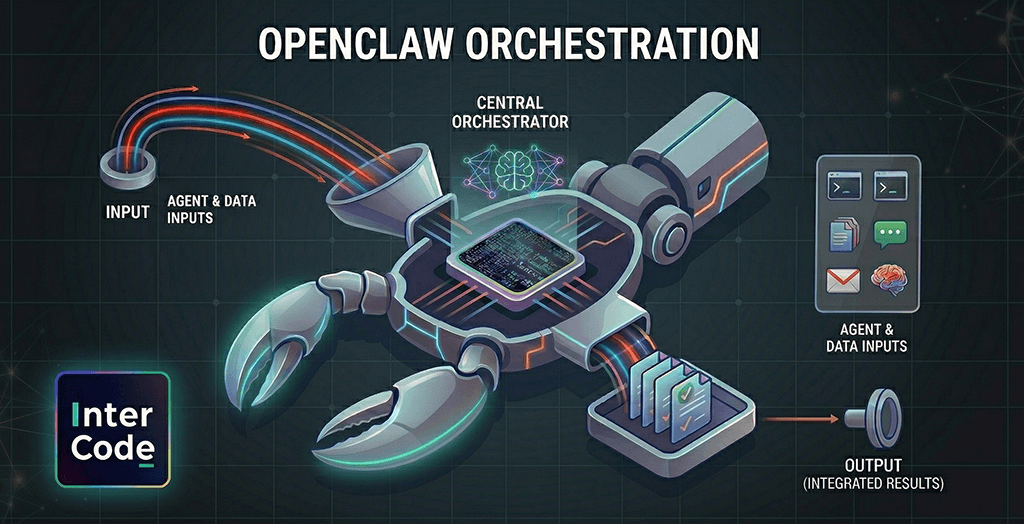
Multi-agent orchestration in OpenClaw: how does it work under the hood?
OpenClaw seems like AGI, but it's pure engineering. Discover the five input types that drive this open-source agent runtime to appear proactive.
Vibe Coding vs. Spec-Driven Development: The Future of AI-Assisted Software Engineering in 2026
Discover why the software engineering industry is shifting from iterative "vibe coding" to structured spec-driven development for AI-assisted coding in 2026.
Frequently Asked Questions
AI integration services cover the full process of embedding AI capabilities into your existing software — from technical planning and API integration to middleware development, testing, deployment, and monitoring setup. At InterCode, this includes LLM integration (OpenAI, Claude, Gemini), RAG pipeline setup, vector database configuration, prompt management systems, and observability tooling.
We use an incremental integration approach — starting with the lowest-risk, highest-value touchpoint, deploying behind feature flags, and rolling out gradually. We avoid big-bang deployments. Every integration goes through staging, load testing, and a canary release before full production exposure. This means you keep shipping your existing product while we extend it with AI.
LLM integration specifically refers to connecting large language model APIs (like OpenAI or Anthropic) into your product. AI integration is a broader term covering any AI system — LLMs, vision models, recommendation engines, classification models, and automation workflows. In practice, most of our current engagements involve LLM integration as the primary component, often combined with vector databases and AI orchestration layers.
Yes — openai integration services are one of our most common engagements. We integrate GPT-4o, GPT-4 Turbo, and embedding models into existing SaaS platforms, handling authentication, rate limiting, streaming, error handling, and cost management. We also build the prompt management layer and observability tooling so you can monitor and optimise the integration over time.
A simple LLM feature integration (e.g., adding a chat interface or summarisation feature to an existing product) typically takes 2–4 weeks. A more complex ai system integration — such as a multi-provider RAG pipeline with vector search and monitoring — takes 6–10 weeks. We provide a detailed timeline after a technical assessment of your current stack.
Ready to Integrate AI Into Your Product?
Describe what you want to add. We will assess your current stack and provide a technical integration plan — including effort estimate, architecture outline, and recommended providers — within 48 hours.
Contact Us