How Much Does Fintech App Development Cost? Budget Tiers, Compliance, and Vendor Fees
The global FinTech market reached approximately $394.88 billion in 2025. The numbers show it will hit $460.76 billion in late 2026, growing at an 18% CAGR. Total funding bounced back to $116 billion last year after hitting a dangerous multi-year low. This rebound means competition is getting fierce. If business leaders expect to survive, they need a clear understanding of FinTech app development budgets.
Building a financial app is far more difficult than creating a standard mobile application. The true financial demands of development depend on 5 specific vectors:
Functional scope
Compliance demands
External links
Security posture
Platform choices
Founders often face sticker shock when they realize that basic user interfaces represent only a fraction of the total bill. It is the hidden structural engineering that consumes the capital.
For the CEO, CTO, COO, and investment partners, the primary challenge lies in distributing capital in a way that minimizes burn rate while meeting strict regulatory standards. If you are not careful, you will bleed cash faster than a software startup in a hype cycle.
According to InterCode analysts, founders consistently underestimate compliance requirements during early sprint planning. This oversight delays the launch by 3 to 6 months, burning valuable investor capital. Let us examine the actual FinTech app development cost behind these development tracks.
FinTech App Development Cost Breakdown 2027
Setting realistic expectations for your FinTech app development budget is critical. Trying to build a complex neobank on an MVP budget is a recipe for a failed launch.
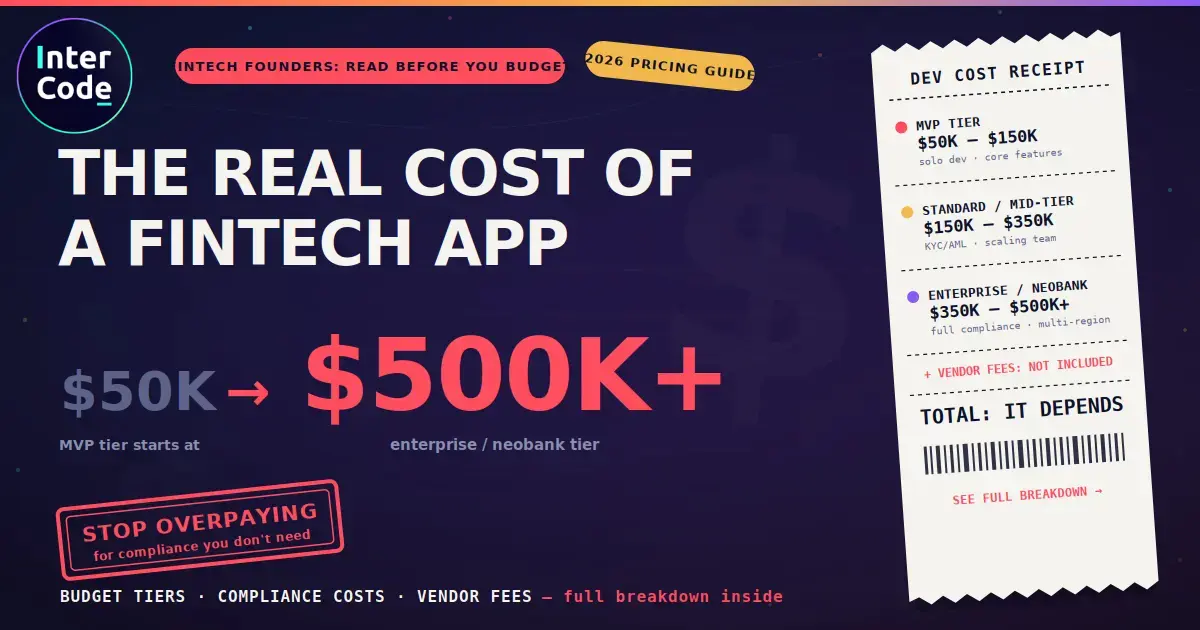
So, how much does it cost to develop a banking app? According to our experts, project budgets generally fall into 3 distinct tiers based on functional complexity, compliance exposure, and deployment scale.
| Budget Tier | Estimated Cost Range (USD) | Expected Timeline | Essential Functional Scope | Regulatory & Compliance Scope |
| Basic MVP Tier | $50,000 - $150,000 | 3 to 6 months | Single payment flow, balance dashboard, basic transfer capability | Basic KYC, Plaid link via third-party widgets, SAQ-A |
| Standard Mid-Tier | $150,000 - $350,000 | 4 to 8 months | Multiple transaction flows, bank linking, credit scoring, biometrics | Multi-jurisdiction KYC/AML, SAQ-D, SOC 2 readiness |
| Enterprise/Neobank Tier | $350,000 - $500,000+ | 9 to 18 months | Full card issuing, custom balances ledger, AI fraud blocking, robo-advisory | PCI DSS Level 1 ROC, PSD2 open banking license, high capital adequacy tracking |
Regardless of the budget tier, capital is usually distributed across the same project phases. Our experience shows that coding represents about half the total cost, while testing and compliance consume significant portions.
| Project Phase | Percentage of Total Budget | Critical Deliverables & Activities | Main Downstream Consequence of Underfunding |
| Discovery & Requirements Mapping | 5% - 10% | Competitive scoping, compliance planning, database mapping | Development timelines double due to mid-project code adjustments |
| UI & UX Design | 10% - 15% | Journey mapping, clickable prototypes, visual styling systems | Unattractive interfaces that destroy user trust |
| Frontend & Backend Coding | 40% - 50% | API connection, database setup, business logic deployment | Unstable codebase, system crashes, data mapping issues |
| Quality Assurance & Testing | 15% - 20% | Penetration testing, compliance checks, API stress tests | Post-launch system bugs, data leaks, failed audits |
| Deployment & Infrastructure Setup | 5% - 8% | Cloud setups, automated pipelines, monitoring tooling | Severe app slowdowns, high cloud invoices |
We think a major error is cutting the testing or discovery budgets. Doing so typically leads to system bugs and high churn rates after launch. It costs much more to fix a database bug on a live system than during the design phase.
Next, let's discuss the details that affect the final cost to build a FinTech app.
PCI-DSS Compliance Costs: Cardholder Data Environment Architecture and Fees
| Merchant Level | Annual Transaction Threshold | Validation Mechanism | US Annual Cost Range (USD) | Western Europe & UK Cost Range (USD Eq.) | Asia-Pacific Cost Range (USD Eq.) |
| Level 1 | Over 6 million card transactions | Annual QSA Assessment & Report on Compliance (ROC) | $18,000 - $60,000 | $15,000 - $52,000 | $12,000 - $45,000 |
| Level 2 | 1 to 6 million card transactions | Annual Self-Assessment Questionnaire (SAQ); occasional QSA | $6,000 - $20,000 | $5,200 - $17,500 | $4,500 - $16,000 |
| Level 3 | 20,000 to 1 million transactions | Annual Self-Assessment Questionnaire (SAQ) | $2,000 - $10,000 | $1,700 - $8,700 | $1,500 - $7,500 |
| Level 4 | Under 20,000 e-commerce transactions | Annual SAQ | $500 - $3,000 | $430 - $2,600 | $400 - $2,000 |
Compliance is a foundational block of your FinTech platform. If a team treats compliance as a checklist at the end of the project, they are setting themselves up for a hard pill to swallow. Retrofitting security controls after coding can increase development costs by 300% to 400%.
Any application that processes card payments is subject to the Payment Card Industry Data Security Standard. This standard is a contract-based rule enforced by payment networks and acquiring banks. Under the updated PCI-DSS v4.0 standard, requirements are split into twelve specific control groups. The transaction volume determines the validation track. Level 1 merchants processing over six million card transactions annually must go through a formal audit by an external Qualified Security Assessor. On the flip side, Level 4 merchants processing under 20,000 online payments can validate using a Self-Assessment Questionnaire.
We think the most efficient way to save money is to reduce the boundaries of your card data environment. By using payment widgets like Stripe Elements, card details go directly to a compliant vault without touching your servers. This simple architectural choice moves you from a painful Level 1 QSA audit to a basic SAQ-A questionnaire. Honestly, this saves about $40,000 to $50,000 in annual audit fees. It also keeps sensitive files off company servers.
| Merchant Level | Months 1–3 Penalty (USD/Month) | Months 4–6 Penalty (USD/Month) | Month 7+ Penalty (USD/Month) |
| Level 1 | $25,000 | $100,000 | $100,000+ |
| Level 2 | $10,000 | $50,000 | $100,000 |
| Level 3 | $5,000 | $25,000 | $50,000–$100,000 |
| Level 4 | $5,000 | $25,000 | $100,000 |
If cardholder files are breached during a period of non-compliance, the financial damage is devastating. A forensic examination costs between $50,000 and $500,000. Lawsuits, settlements, and customer notifications can push the total past $1.2 million. This makes compliance a cheap insurance policy.
PSD2 and Strong Customer Authentication: Licensing Costs and Engineering Requirements
Let us look at European and United Kingdom markets under the Revised Payment Services Directive. The regulation demands Strong Customer Authentication for most online payments and account access. Payer verification must use at least two independent factors: knowledge, possession, and inherence.
Older verification methods like SMS codes are now considered insecure. Instead, modern systems require physical devices tied to biometrics. At the same time, remote payments must meet a strict rule called dynamic linking. The verification code must be cryptographically bound to the specific payment amount and the specific receiver. If an attacker attempts to modify the payment destination mid-transit, the authorization code becomes invalid immediately.
New service providers in Europe face strict capital requirements to operate under PSD2:
Account Information Service Providers must secure registration and hold an initial minimum capital of EUR 20,000.
Payment Initiation Service Providers must obtain a full license, which requires an initial and ongoing minimum capital of EUR 50,000.
Both types of providers must hold professional indemnity insurance to cover potential user and bank liabilities.
| SCA Factor | Definition | Common Implementation Methods | Architectural & Security Requirements |
| Knowledge | Something only the user knows | PIN codes, passwords, secret patterns | Must remain separate; compromise of one factor must not weaken other elements. |
| Possession | Something only the user possesses | Mobile phone with cryptographic token, hardware token | Device identifier must be footprinted by software issuer; token must use hardware secure element. |
| Inherence | Something the user naturally is | Fingerprints, facial scans, behavioral biometrics | Biometric data must employ active liveness detection to block deepfakes and spoofing. |
Understanding SCA exceptions is critical for keeping user friction low. The Regulatory Technical Standards allow several exemptions where contactless or remote transactions do not require two-factor checks. Low-value remote payments below EUR 30 are exempt. Yet, full SCA must trigger if the user makes five consecutive exempt transactions or if the cumulative spend exceeds EUR 100.
Another common exemption is Transaction Risk Analysis, which allows frictionless checkout for payments up to EUR 500 if the provider's overall fraud rate is below strict thresholds (ranging from 0.01% to 0.13% depending on transaction value). If an issuer bank detects wonky payment patterns, they can override these exemptions and demand full step-up authentication.
Payment API and Ledger Costs: Stripe, Plaid, and In-House Architecture Pricing
No financial system can operate without connections to payment networks and bank ledgers. Building these links means paying setup fees and transaction charges.
Stripe is a common choice for credit card processing. Truth be told, it costs nothing to open a standard account. However, the fees stack up rapidly once transactions start flowing. The basic rate for online cards in the United States is 2.9% plus 30 cents per payment. International cards add another 1.5%, and currency conversion adds a 1% fee. This means a cross-border charge can consume 5.4% of your transaction value.
Stripe add-ons also increase transaction costs. Stripe Billing adds a flat 0.7% fee on billing volume. Turn on basic tax calculations, and Stripe Tax adds another 0.5% per transaction. Fraud protection using Stripe Radar for Teams costs up to 7 cents per transaction. For identity checks, Stripe Identity charges $1.50 per verification. If your company processes over $80,000 per month, negotiating a custom contract with Stripe is recommended.
Plaid is the dominant provider for bank account connection and data aggregation. It allows users to link their bank accounts securely. Pay-as-you-go connection plans start at $0.30 to $0.80 per linked account. For scaling platforms, Plaid setup fees can reach $25,000. Monthly minimum contracts range from $1,000 to $10,000. Every single API request adds to the bill. Syncing transaction history costs about $0.30 to $0.60 per call. Account verification costs between $0.10 and $0.25.
| Provider / Service | Upfront Setup Cost (USD) | Monthly Commitment / Fee | Variable Transaction / API Call Fee |
| Stripe Card Payments | $0 setup fee | $0 monthly subscription | 2.9% + 30¢ domestic; +1.5% international card; +1% currency conversion |
| Stripe Billing | $0 setup fee | $0 monthly fee | 0.7% of total billing volume |
| Stripe Identity | $0 setup fee | $0 monthly fee | $1.50 per customer verification check |
| Stripe Connect Express | $0 setup fee | $2.00 per active account per month | 0.25% + 25¢ per outbound payout |
| Plaid Open Banking Link | $5,000 - $25,000 setup | $1,000 - $10,000 monthly minimum | $0.10 - $0.25 for account validation; $0.30 - $0.60 for transaction history sync |
| Plaid Identity Verification | $0 setup fee | Usage-based | $1.00 - $2.00 per identity verification check |
Ledger-as-a-Service (LaaS) vs a custom in-house ledger
Beyond API links, every FinTech app must manage account balances using a ledger. This ledger is the system of record. Many startup teams assume they can write a simple database table for this. That is a bad idea. Ledger errors lead to balance drift, which destroys user trust.
This is why FinTech teams face a choice: deploy Ledger-as-a-Service (LaaS) or build a custom ledger. LaaS providers like Modern Treasury charge transaction fees ranging from $0.10 to $0.50 with monthly minimums starting around $5,000. This works well for early-stage products. But if transaction volumes exceed ten million per year, LaaS becomes a major drain on capital.
Building an in-house ledger system requires serious engineering. According to our analysts, you need 7 to 11 senior developers working for 20 to 27 months. That means $2 million to $4 million in engineering salaries alone. Database clusters and monitoring tools add another $10,000 to $30,000 per month.
| Structural Feature | Ledger-as-a-Service (LaaS) | Custom In-House Ledger |
| Initial Setup Timeline | 6 to 18 months of system interfacing | 20 to 27 months of full system development |
| Upfront Financial Outlay | $50,000 - $200,000 setup costs | $2 million - $10 million development costs |
| Monthly Operating Costs | $5,000 - $50,000 volume-based fees | $20,000 - $100,000 (staff & dedicated servers) |
| Compliance Backing | Pre-built SOC 2, SOX, and audit tools | Must build and validate all compliance reporting internally |
| Systemic Customization | Limited to vendor API capabilities | Total control over features and financial logic |
| Lock-in Risk | High; migration of data is highly complex | Zero; your team owns all infrastructure and data |
FinTech Security Testing Costs: Penetration Testing and Vulnerability Audits
| Testing Category | Average Cost (USD) | Standard Duration | Primary Technical Focus | Ideal Target Environment |
| SaaS & Web App | $5,000 - $30,000 | 1 to 3 weeks | OWASP Top 10, authentication, session hijacking | Web platforms, user dashboards, admin consoles |
| API & Microservices | $5,000 - $20,000 | 1 to 2 weeks | REST/GraphQL endpoints, broken authorization, IDOR | Backend payment loops, webhook receivers |
| Mobile App (iOS/Android) | $5,000 - $30,000 | 1 to 2 weeks | Cryptographic storage, biometrics, runtime defenses | Native mobile packages, client-side code |
| Cloud & Identity Infrastructure | $10,000 - $40,000+ | 1 to 3 weeks | IAM policies, Kubernetes, CI/CD pipeline access | AWS, GCP, or Azure multi-account architecture |
| Red Team Simulation | $40,000 - $150,000+ | 2 to 6 weeks | Operational stealth, multi-vector penetration, social engineering | Large multi-region enterprise environments |
Financial platforms are prime targets for cyber criminals. A weak security posture will lead to regulatory fines and rapid customer churn. We think manual testing is mandatory because scanners miss complex logic flaws.
In 2027, a standard commercial penetration test costs between $10,000 and $35,000. Tightly scoped web application or mobile assessments start around $5,000. However, complex environments involving cloud platforms, APIs, and microservices push costs much higher. A deep review of a cloud environment with active directory access often ranges from $25,000 to $150,000.
Under the updated PCI DSS v4.0 rules, Requirement 11.4 demands a formal, documented pen testing process. Testers must use standards like OWASP or NIST. Crucially, all APIs connected to the card data environment are now explicitly in scope. You cannot just run automated vulnerability tests anymore.
By the way, retest fees catch many CTOs off guard. While some firms include a quick check of high-severity flaws, a full retest often costs 30% to 50% of the initial quote. If the first test was $25,000, you are on the hook for another $12,000 for verification. Remediation is also a massive internal expense. A three-week sprint to patch vulnerabilities can easily consume $18,000 to $30,000 of engineering time.
InterCode Experience: 12 Tips On How To Reduce FinTech App Development Costs

Launching a financial application is an exercise in risk management. Security and compliance are the most expensive things to get wrong. Here is what we recommend you do:
Establish Funding Milestones Early. Ensure your development stages align with your venture capital rounds. Do not plan a full multi-region launch on a seed-stage budget. Use a single-flow MVP to validate your business model first.
Budget for Yearly Upkeep. Expect to pay 15-25% of your initial build cost every year for server fees, compliance updates, API licenses, and security checks.
Examine Legal Boundaries. Build compliance steps into your marketing plans. Identity checks and transaction monitoring are key parts of FinTech business.
Restrict the Card Data Environment Scope. Use browser-side payment systems like Stripe Elements to keep credit card numbers off your servers. This simple choice moves your company to a simpler SAQ validation tier and reduces security risks.
Deploy a Double-Entry Ledger System. Avoid balance drift by building an immutable transaction ledger. For high-volume projects, plan to build an in-house ledger to avoid expensive per-transaction fees from LaaS providers.
Plan for API Swappability. Wrap third-party compliance and payment APIs behind your own custom code layer. This ensures you can switch identity validation or open-banking providers in under three weeks if they raise their prices.
Optimize Customer Onboarding Funnels. Monitor user drop-off points during identity verification. A slow verification process will lead to high acquisition costs.
Manage Vendor Contracts Diligently. Review transaction limits and monthly commitments for services like Plaid, Stripe, Veriff or Sumsub. You can lose massive amounts of cash on unused contract minimums.
Establish Disaster Recovery Protocols. Work with your security team to build real-time monitoring and backup systems.
Evaluate the Compliance Infrastructure Balance Sheet. Before backing a startup, verify that the regulatory plan is sound. A company that has not planned for PCI-DSS or local open banking licenses is dangerous.
Monitor the Productive-to-Unproductive Capital Ratio. Verify that engineering funds are going into product development rather than remediation sprints. Teams that ignore compliance early on will spend up to 40% of their Series A funding fixing basic structural errors.
Use Near-Shore Economic Models. Encourage portfolio companies to use hybrid development teams. Relying on partners in Eastern Europe can cut labor costs in half while keeping quality high.
If you consider developing AI for your project, we recommend you read our article discussing vibe coding vs. spec-driven development.
Partner with InterCode to Develop a FinTech App
InterCode is a custom development company with deep expertise in FinTech projects. Operating at average hourly rates between $50 and $99, our firm delivers FinTech development services of varying complexity.
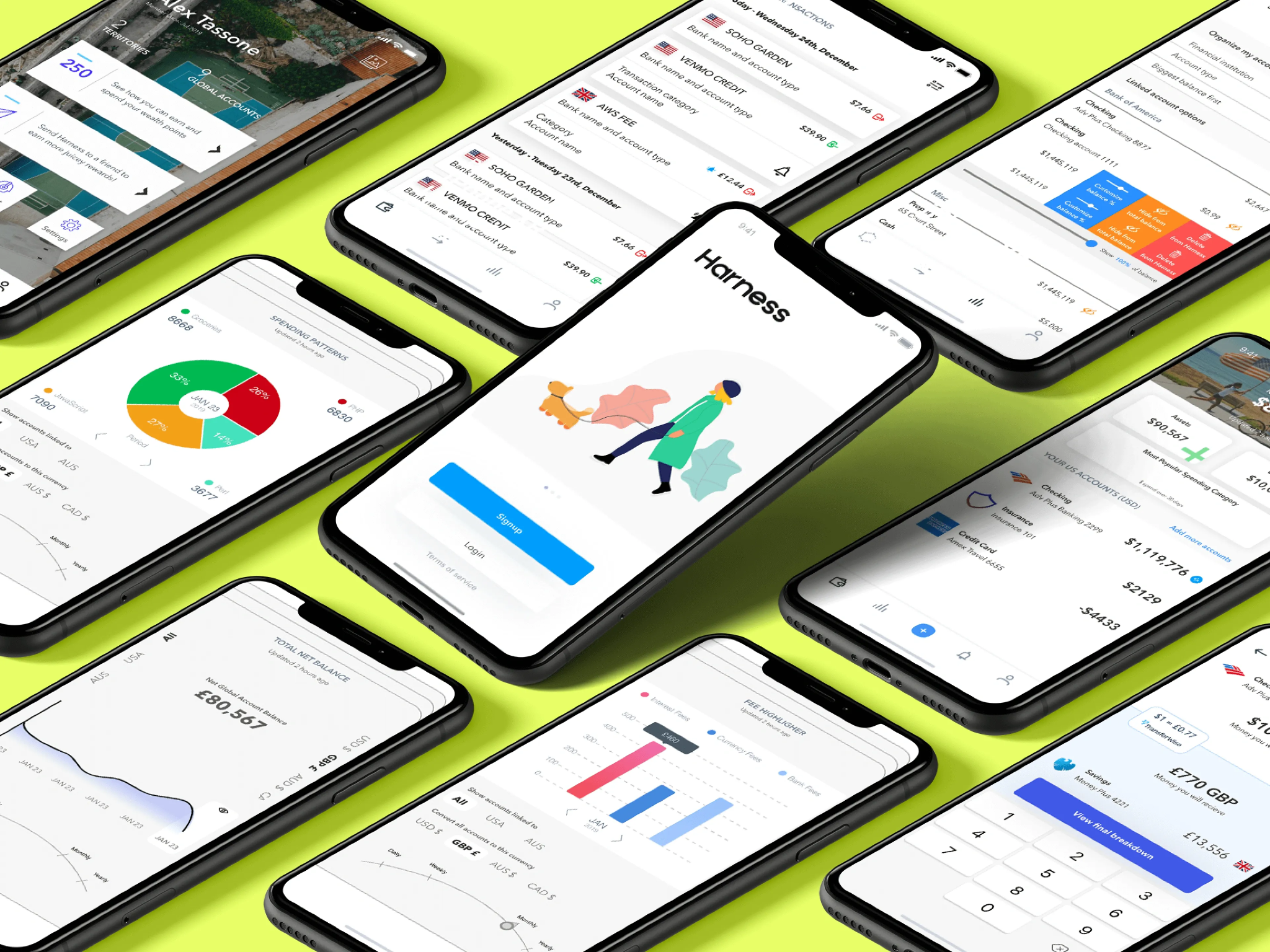
One of our major FinTech projects is the Harness Mobile Banking App. InterCode collaborated with Harness to build this global banking system. This project highlights our capacity to construct cross-platform mobile systems for both iOS and Android devices.
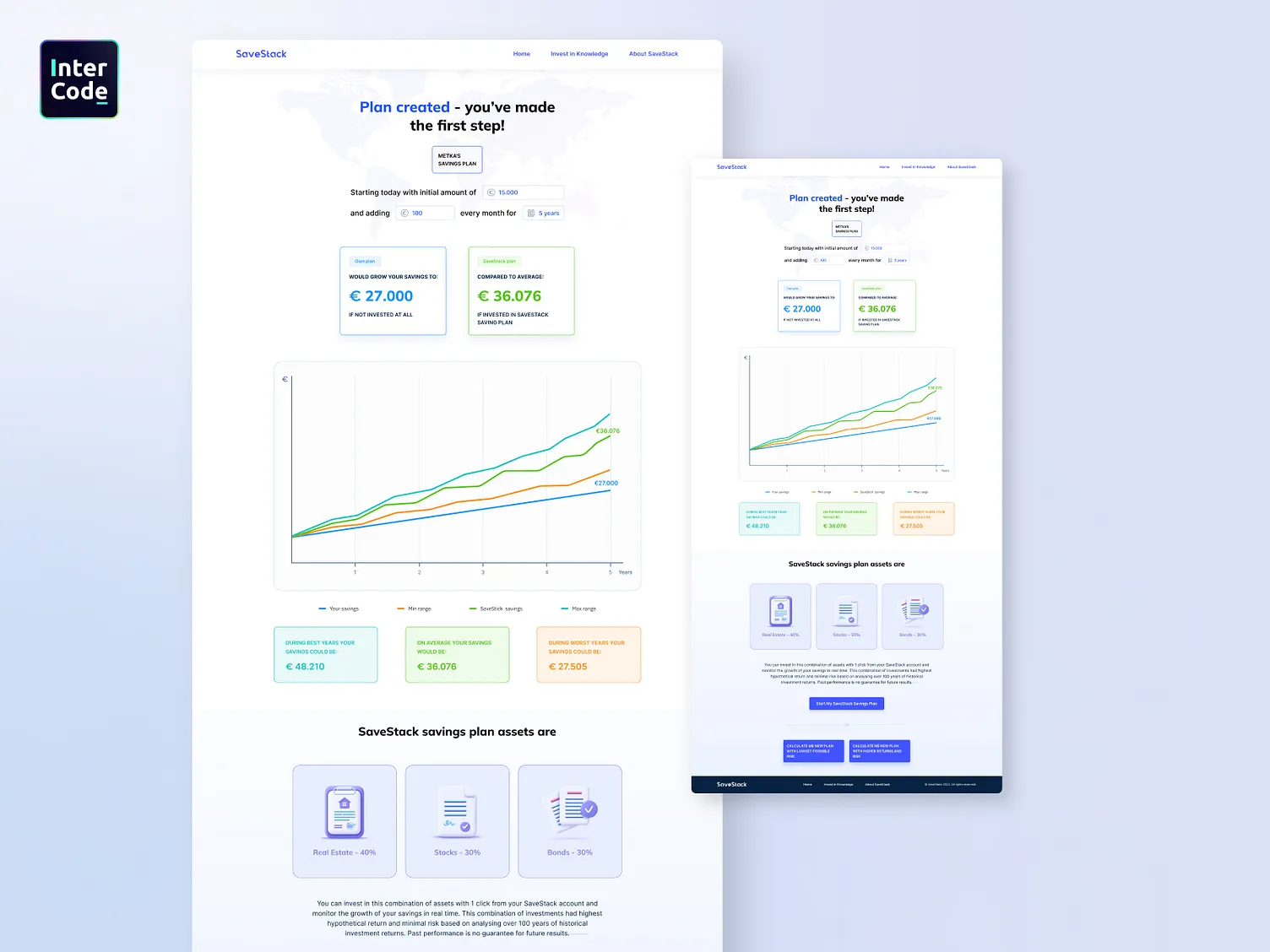
Another notable project is SaveStack, an investment stock exchange platform designed by InterCode. The system allows users to invest in traditional currencies like USD, EUR, and GBP alongside digital assets and cryptocurrencies. It features a streamlined onboarding system, real-time investment tracking, and a clear breakdown of transaction costs to build trust. Built using a modern technical stack including React, Node.js, and Amazon Web Services, it represents a classic mid-tier financial build.
If you need our help with Fintech project development or a consultation, feel free to contact us.
 26 likes