LangGraph Alternatives for Agent Orchestration: What We Learned Running All of Them
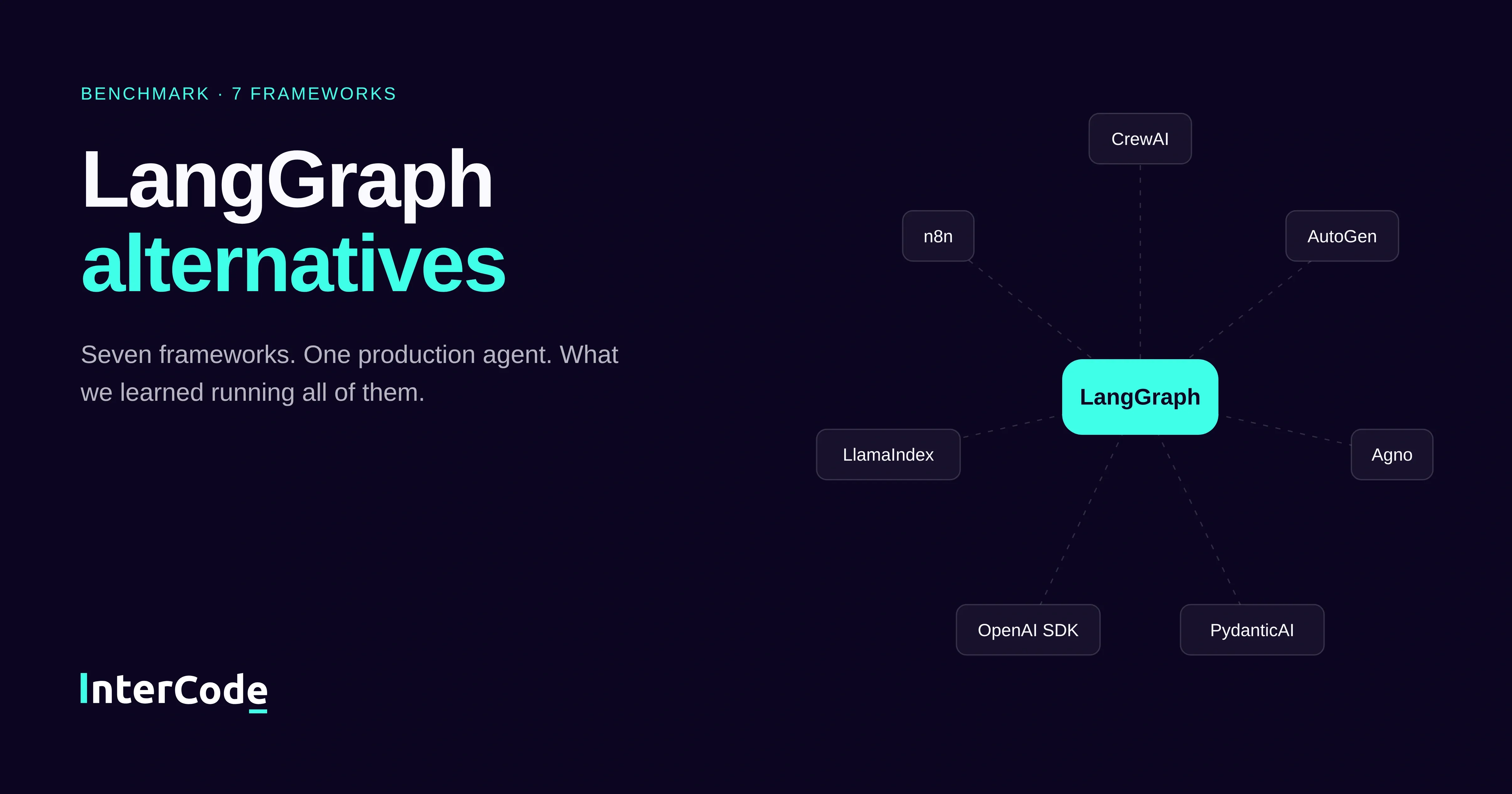
Evaluating viable LangGraph alternatives requires testing runtime behavior under real production conditions. To see whether alternative agent frameworks perform better, we tested CrewAI, AutoGen, Agno, PydanticAI, OpenAI Agents SDK, LlamaIndex Workflows, and n8n.
Teams building transactional agent pipelines gain substantial advantages in latency, cost, and developer experience by adopting lighter, schema-driven alternatives. When deciding between LangChain vs LangGraph, we recommend reserving LangGraph strictly for complex state machines that require durable multi-turn persistence.
Why teams leave LangGraph: production failure modes
To understand why engineering teams migrate away from LangGraph, you must first answer a basic architectural question: What is LangGraph?
LangGraph is an open-source library within the LangChain ecosystem that models agent control flow as cyclical, directed graphs, coordinating state transitions across nodes and edges using a centralized persistence layer. While this directed graph abstraction is theoretically sound, operating it at scale introduces operational failure modes that rarely manifest during local prototyping.
Reason #1: state explosion
The most prevalent failure mode in long-running production systems is state explosion. LangGraph accumulates state within a global schema, passing the complete conversation history, scratchpad data, and tool payloads between every node invocation. In high-throughput environments, this design causes rapid context bloat
As intermediate JSON payloads and API responses compound inside the shared state, serialization overhead multiplies. This leads to increased memory footprints, degraded garbage collection efficiency, and unexpected context window truncation.
Reason #2: distributed graph operations
Debugging distributed graph operations under operational pressure presents another major barrier. When an agent fails during execution, standard Python tracebacks decouple because the fault originates inside the underlying Pregel graph engine rather than user code.
Pinpointing whether an error stems from an edge routing condition, an unhandled tool schema, or an invalid state update requires traversing multiple layers of internal abstractions. Without proprietary distributed tracing suites, diagnosing cyclical routing failures or dropped events during production incidents becomes exceptionally difficult.
Reason #3: checkpointing mechanics
Operational bottlenecks also emerge from LangGraph's checkpointing mechanics. To support state restoration and human-in-the-loop workflows, LangGraph persists snapshots after node executions.
When handling concurrent production traffic across relational databases such as PostgreSQL, serializing expansive state dictionaries via JSON or binary serialization creates database connection pool exhaustion and elevated I/O wait times. What should be sub-second inference calls degrade into multi-second latency spikes as persistent checkpointers compete for disk writes.
Reason #4: Ongoing maintenance
Finally, ongoing maintenance is complicated by dependency churn across the broader LangChain ecosystem. Upstream framework updates routinely modify base interfaces, alter tool-binding signatures, and deprecate core helpers. Engineering teams often find themselves rewriting working graph topologies simply to maintain compatibility with minor library revisions, adding continuous maintenance overhead to active deployments.
LangChain vs LangGraph: architectural boundaries and migration trade-offs
The industry discourse surrounding LangChain vs LangGraph highlights a persistent misunderstanding regarding where linear abstraction ends and stateful graph coordination begins.
LangChain was architected primarily around Directed Acyclic Graph (DAG) pipelines using the LangChain Expression Language (LCEL). In an LCEL pipeline, data flows forward deterministically. An input string:
Maps to a prompt template
Feeds directly into a language model
Resolves through an output parser
This design is effective for linear extraction, simple retrieval-augmented generation (RAG), and deterministic data transformations.
The distinction between LangGraph and LangChain centers on cyclical control flow and mutable state. Linear chains cannot natively represent agentic behavior, where a model must evaluate the outcome of its own action, correct errors, and loop until a completion condition is reached. LangGraph addresses this limitation by treating the workflow as a cyclic finite state machine, allowing execution to loop back to prior nodes based on conditional edge logic.
| Architectural Dimension | LangChain (LCEL) | LangGraph |
| Execution Topology | Strictly acyclic Directed Acyclic Graphs (DAG); linear execution. | Cyclical execution graphs; dynamic edge branching and iterative loops. |
| State Management | Ephemeral; state flows linearly through inputs and outputs. | Centralized, persistent state dictionary with custom merge reducers. |
| Debugging Complexity | Linear execution traces; standard stack traces surface directly. | Graph engine execution; stack traces decouple across internal Pregel loops. |
| Developer Onboarding | Low to moderate; standard functional composition mechanics. | High; requires graph modeling, reducer mechanics, and state schema design. |
| Infrastructure Overhead | Negligible; stateless compute nodes scale horizontally. | Significant; requires database-backed checkpointers for production state. |
| Optimal Production Fit | Fixed ETL pipelines, document parsing, and single-turn RAG search. | Multi-agent coordination, iterative loops, and human-in-the-loop workflows. |
Migrating an application from LangChain to LangGraph requires substantial architectural changes. Linear LCEL components cannot be wrapped into a graph without redesigning the entire state handling model. Developers must decompose monolithic chains into discrete node functions, construct explicit typing schemas, write reduction logic to merge concurrent updates, and define conditional routers for every branching path. When a workflow merely calls two deterministic APIs and summarizes the findings, refactoring into LangGraph introduces substantial code overhead without providing tangible reliability benefits.
How we tested: reference workload and evaluation architecture
To evaluate each alternative on equal footing, the testing framework avoided simplistic single-turn prompts and instead implemented a production-grade customer support remediation agent. This workload reflects real enterprise challenges:
Parsing ambiguous user inputs
Querying backend systems
Executing business logic
Outputting structured JSON conforming to strict schemas
The agent had access to two deterministic tools: an order tracking interface (lookup_order_status) and an SLA refund calculator (calculate_shipping_refund). The evaluation required the agent to:
Ingest a customer complaint
Parse the relevant order identifier
Retrieve delivery telemetry
Apply SLA compensation rules based on shipping delays
Generate a validated Pydantic model containing an executive summary, numerical compensation amounts, and escalation flags
The benchmarking methodology was strictly standardized across all 7 frameworks. Each implementation targeted OpenAI's gpt-4o (model release gpt-4o-2024-08-06) via direct API calls at a fixed temperature of 0.0 to minimize model non-determinism. The benchmark ran one hundred automated iterations per framework inside containerized Linux environments (AWS c6i.2xlarge instances with 8 vCPUs and 16 GB of RAM) over dedicated network connections.
Python
from dataclasses import dataclassfrom typing import Optionalfrom pydantic import BaseModel, Fieldclass OrderDetails(BaseModel):order_id: strstatus: strdays_delayed: intbase_shipping_cost: floatclass RemediationOutput(BaseModel):summary: str = Field(description="Operational summary of the resolution")refund_amount: float = Field(description="Total monetary refund awarded")action_required: bool = Field(description="Whether human intervention is needed")status_code: str = Field(description="Internal operational status code")def lookup_order_status(order_id: str) -> dict:"""Retrieves order logistics, status, and shipping metrics."""database = {"ORD-8821": {"order_id": "ORD-8821", "status": "delayed", "days_delayed": 4, "base_shipping_cost": 29.50},"ORD-4410": {"order_id": "ORD-4410", "status": "delivered", "days_delayed": 0, "base_shipping_cost": 15.00},}return database.get(order_id, {"error": "Order identifier not found"})def calculate_shipping_refund(days_delayed: int, base_cost: float) -> float:"""Calculates eligible customer compensation based on delivery delay."""if days_delayed <= 1:return 0.0elif 2 <= days_delayed <= 3:return round(base_cost * 0.5, 2)return round(base_cost * 1.0, 2)
7 measured LangGraph alternatives
The empirical benchmark revealed clear performance divides across the frameworks. Runtimes optimized for type safety and direct function invocation achieved the lowest latency and token usage, whereas conversational multi-agent frameworks suffered from prompt inflation and non-deterministic looping.
| Framework | Lines of Code (LOC) | Median Latency (p50) | Tail Latency (p95) | Token Cost / 1k Runs | Failure Rate (100 Runs) | Learning Curve | Production Verdict |
| LangGraph (Baseline) | 114 | 2.42s | 3.88s | $18.42 | 2.0% | Steep | Heavyweight, stateful control. |
| CrewAI | 68 | 3.65s | 5.41s | $36.80 | 5.0% | Low-Medium | Role-based, token-intensive. |
| AutoGen | 82 | 3.88s | 6.12s | $41.25 | 7.0% | Moderate | Conversational bloat, unpredictable. |
| Agno | 42 | 1.84s | 2.76s | $16.10 | 0.0% | Very Low | Fast, lightweight runtime. |
| PydanticAI | 46 | 1.89s | 2.81s | $16.22 | 0.0% | Low-Medium | Type-safe, production-ready. |
| OpenAI Agents SDK | 38 | 1.78s | 2.65s | $15.95 | 0.0% | Low | Minimalist, clean handoffs. |
| LlamaIndex Workflows | 89 | 2.31s | 3.64s | $17.50 | 1.0% | Moderate | Event-driven, RAG-optimized. |
| n8n | Visual/JSON | 2.95s | 4.45s | $19.10 | 3.0% | Very Low | Visual workflows, low-code ops. |
CrewAI
CrewAI coordinates agents using human organizational structures, assigning each agent distinct roles, goals, and backstories. The framework organizes execution into sequential or hierarchical tasks managed by coordinating agents.
Python
from crewai import Agent, Task, Crew, Processfrom crewai.tools import tool@tool("Order Lookup")def order_lookup_tool(order_id: str) -> str:"""Lookup order status by identifier."""return str(lookup_order_status(order_id))@tool("Refund Calculation")def refund_calc_tool(days_delayed: int, base_cost: float) -> str:"""Calculate refund based on delay and cost."""return str(calculate_shipping_refund(days_delayed, base_cost))triage_agent = Agent(role="Order Resolution Specialist",goal="Triage customer orders and calculate accurate refunds.",backstory="Senior support engineer dedicated to fair customer compensation.",tools=[order_lookup_tool, refund_calc_tool],verbose=False)remediation_task = Task(description="Analyze order {order_id}. Determine delays and compute refunds.",expected_output="Structured remediation summary matching corporate policy.",agent=triage_agent)crew = Crew(agents=[triage_agent],tasks=[remediation_task],process=Process.sequential)result = crew.kickoff(inputs={"order_id": "ORD-8821"})
CrewAI enables rapid prototyping through intuitive abstractions. In production environments, however, injecting persona prompts and background instructions into every LLM call creates significant token overhead. The framework's internal coordination logic requires extra prompt round-trips to manage task handoffs.
CrewAI is well-suited for creative content generation and synthetic research, but its high token usage and looser runtime control make it less practical for latency-critical transactional systems.
AutoGen
Microsoft's AutoGen framework structures multi-agent coordination as multi-turn conversations between autonomous agents (ConversableAgent, AssistantAgent, UserProxyAgent).
Python
import osfrom autogen import AssistantAgent, UserProxyAgent, register_functionllm_config = {"config_list": [{"model": "gpt-4o", "api_key": os.environ["OPENAI_API_KEY"]}],"temperature": 0.0,}assistant = AssistantAgent(name="RemediationAssistant",system_message="Calculate shipping refunds. Call lookup then calculate. Reply TERMINATE when finished.",llm_config=llm_config,)user_proxy = UserProxyAgent(name="ExecutionProxy",human_input_mode="NEVER",max_consecutive_auto_reply=3,is_termination_msg=lambda x: "TERMINATE" in (x.get("content") or ""),code_execution_config=False,)register_function(lookup_order_status,caller=assistant,executor=user_proxy,name="lookup_order_status",description="Fetch order status",)register_function(calculate_shipping_refund,caller=assistant,executor=user_proxy,name="calculate_shipping_refund",description="Compute refund",)user_proxy.initiate_chat(assistant,message="Process delayed shipment remediation for order ORD-8821.",)
AutoGen offers strong flexibility for open-ended problem solving and sandboxed code execution. For structured backend operations, however, using conversation as an execution driver introduces unpredictability. Agents can enter circular dialogues or fail to process termination tokens.
AutoGen works best in exploratory environments where dynamic debate adds value, rather than strict transactional APIs.
Agno
Agno (formerly Phidata) is an open-source framework designed for lightweight, high-performance agent execution. It bypasses graph abstractions and conversational overhead in favor of direct execution loops.
Python
from agno.agent import Agentfrom agno.models.openai import OpenAIChatorder_agent = Agent(model=OpenAIChat(id="gpt-4o"),tools=[lookup_order_status, calculate_shipping_refund],response_model=RemediationOutput,instructions=["Lookup the order status by ID.","Calculate the refund if delayed.","Return the final structured remediation output."],markdown=False)response = order_agent.run("Process delayed shipment remediation for order ORD-8821.")
Agno demonstrated excellent efficiency in the benchmark suite. Tool schemas are compiled cleanly into native API formats without extra wrapper instructions, keeping token costs low.
For teams deploying agents as containerized microservices behind REST endpoints, Agno provides a lean, performant architecture.
PydanticAI
Maintained by the core Pydantic development team, PydanticAI applies strict typing and schema validation directly to generative AI workflows.
Python
from pydantic_ai import Agent, RunContextfrom dataclasses import dataclass@dataclassclass TriageContext:service_tier: str = "Enterprise"agent = Agent("openai:gpt-4o",deps_type=TriageContext,result_type=RemediationOutput,system_prompt="Resolve order shipping delays using provided tools.")@agent.tooldef tool_order_lookup(ctx: RunContext[TriageContext], order_id: str) -> dict:"""Fetch order status by order_id."""return lookup_order_status(order_id)@agent.tooldef tool_calculate_refund(ctx: RunContext[TriageContext], days_delayed: int, base_cost: float) -> float:"""Calculate the shipping refund amount."""return calculate_shipping_refund(days_delayed, base_cost)result = agent.run_sync("Evaluate refund for customer order ORD-8821.",deps=TriageContext())
PydanticAI introduces strong software engineering rigor to LLM orchestration. By validating inputs, runtime dependencies, and tool outputs against standard Pydantic models, it catches type mismatches before they cause runtime errors. When a model returns an invalid schema, the runtime prompts the model to self-correct the payload before completing the call.
PydanticAI is an ideal fit for engineering organizations accustomed to FastAPI design patterns.
OpenAI Agents SDK
The OpenAI Agents SDK is a lightweight framework focused on clean multi-agent handoffs, guardrails, and deterministic tool use.
Python
from agents import Agent, Runner, function_tool@function_tooldef fetch_order(order_id: str) -> dict:"""Lookup order status."""return lookup_order_status(order_id)@function_tooldef calculate_refund(days_delayed: int, base_cost: float) -> float:"""Compute refund based on delay."""return calculate_shipping_refund(days_delayed, base_cost)remediation_agent = Agent(name="RemediationSpecialist",instructions="Resolve delayed orders using available tools and summarize remediation.",tools=[fetch_order, calculate_refund],output_type=RemediationOutput)result = Runner.run_sync(remediation_agent,"Remediate delayed customer shipment for ORD-8821.")
The OpenAI Agents SDK registered the lowest median latency and the lowest token expenditure in the benchmark. Its architecture relies on a lean Runner execution loop that executes tool invocations and transfers control ("handoffs") between agents without extra prompt overhead.
While compatible with third-party models via abstraction layers, OpenAI Agents SDK architecture is optimized around OpenAI's native endpoints, which may present lock-in considerations for multi-model deployments.
LlamaIndex Workflows
LlamaIndex Workflows replaces legacy graph abstractions with an asynchronous, event-driven orchestration architecture.
Python
from llama_index.core.workflow import Workflow, StartEvent, StopEvent, step, Eventfrom llama_index.llms.openai import OpenAIclass OrderLookupEvent(Event):order_id: strclass CalculationEvent(Event):days_delayed: intbase_cost: floatclass RemediationWorkflow(Workflow):@stepasync def extract_and_route(self, ev: StartEvent) -> OrderLookupEvent:return OrderLookupEvent(order_id="ORD-8821")@stepasync def fetch_status(self, ev: OrderLookupEvent) -> CalculationEvent:order_data = lookup_order_status(ev.order_id)return CalculationEvent(days_delayed=order_data["days_delayed"],base_cost=order_data["base_shipping_cost"])@stepasync def compute_remediation(self, ev: CalculationEvent) -> StopEvent:refund = calculate_shipping_refund(ev.days_delayed, ev.base_cost)summary = f"Refund of ${refund} processed for {ev.days_delayed} days delay."return StopEvent(result={"summary": summary, "refund_amount": refund})workflow = RemediationWorkflow(timeout=30)
LlamaIndex Workflows is well-suited for systems that integrate agent reasoning with complex retrieval pipelines, vector stores, and document transformation tasks. Steps are decoupled through event emission and subscription, making the pipeline modular.
For workflows focused purely on tool calling without heavy retrieval requirements, however, declaring custom events and step handlers introduces unnecessary boilerplate and mental overhead.
n8n
n8n combines visual node graph execution with low-code automation, allowing teams to run LangChain-compatible agents alongside hundreds of enterprise integrations. For an in-depth architectural breakdown, explore the comparative analysis of LangGraph vs n8n.
JSON
{"nodes": [{"parameters": {"options": {"systemMessage": "You evaluate order delays and calculate refunds using tools."}},"name": "AI Agent Node","type": "@n8n/n8n-nodes-langchain.agent","typeVersion": 1.7,"position": [460, 240]},{"parameters": {"model": "gpt-4o"},"name": "OpenAI Chat Model","type": "@n8n/n8n-nodes-langchain.lmChatOpenAi","position": [460, 460]},{"parameters": {"name": "lookup_order","description": "Fetch order status by order ID","jsCode": "return JSON.stringify(lookup_order_status(query));"},"name": "Custom Code Tool","type": "@n8n/n8n-nodes-langchain.toolCode","position": [680, 380]}]}
n8n offers accessibility for operational teams by providing visual canvases where non-technical stakeholders can review execution runs, adjust system prompts, and inspect tool inputs.
The trade-off lies in software delivery practices. Managing complex orchestration via JSON exports creates Git merge conflicts and makes automated CI/CD testing more difficult than code-first alternatives.
AI agent orchestration beyond framework abstractions
Focusing solely on framework selection overlooks a critical production reality: choosing an AI agent framework solves only the internal execution loop. Whether an engineering team adopts LangGraph, Agno, or PydanticAI, production systems require an external infrastructure layer to maintain reliability, control costs, and ensure observability. Modern multi agent orchestration demands operational controls that exist entirely outside application code.
A dependable production architecture begins with network resiliency and intelligent fallback routing. LLM APIs routinely experience transient rate limits (HTTP 429) and network timeouts (HTTP 504). Upstream agent orchestration frameworks rarely handle these gracefully out of the box. Resilient architectures implement exponential backoff with randomized jitter and route requests through an AI gateway capable of automatic fallback. If a primary frontier model degrades, the runtime should immediately fail over to a secondary provider (e.g., routing from OpenAI to Anthropic or Google Cloud endpoints) without dropping session state. A detailed examination of this architectural layer is available in the breakdown of how our agent runtime works.
Comprehensive observability is equally critical. Basic application logs cannot capture non-deterministic multi-agent executions. Systems require distributed tracing built on OpenTelemetry standards that record nested spans for:
Prompt assembly
Model latency
Tool execution
State persistence
Tracing tools such as Pydantic Logfire, Langfuse, or OpenLIT allow engineers to monitor execution paths, pinpoint latency bottlenecks, and track token spend per user session. Incorporating these observability controls early is a core best practice in the modern agentic SDLC.
Production deployments also require proactive cost controls and rate budgeting. Autonomous agents can enter infinite tool loops if instructions are ambiguous or models hallucinate. Production runtimes must enforce strict token and cost budgets at the session, organization, and tenant levels. Setting up runtime circuit breakers that terminate executions when token limits are breached prevents runaway cloud expenditures.
When you should stay on LangGraph
Despite the performance advantages and simpler ergonomics of newer alternatives, LangGraph remains an effective, production-grade choice for specific architectural requirements. Migrating away from it is often counterproductive in scenarios that demand its unique feature set.
LangGraph excels when managing workflows that form complex, cyclical directed graphs. If an application requires non-linear routing, LangGraph's Pregel engine handles these patterns out of the box. An example of non-linear routing is code verification loops that:
Evaluate outputs
Return execution to a developer node upon errors
Trigger parallel evaluation gates
Merge results through synchronized join nodes
Implementing similar cyclic mechanics in linear libraries like PydanticAI or the OpenAI Agents SDK requires writing custom recursive loops and state management code.
LangGraph is also unmatched for time-travel debugging and stateful execution replays. Its persistence layer saves immutable state snapshots at each graph vertex. The ability to inspect the exact state of an agent, modify a state parameter, and fork execution from that snapshot provides debugging and auditing value that alternative frameworks do not offer natively. This is very valuable for heavily regulated industries such as healthcare, financial services, and legal compliance.
Similarly, long-running, durable workflows benefit directly from LangGraph’s integration with persistent checkpointers. When a process extends across multiple days, waits for external human inputs, and must survive worker restarts or infrastructure failovers, LangGraph recovers state directly from storage and resumes execution without re-running earlier steps.
How to Choose: Decision Matrix for Orchestration Frameworks
Selecting an agent orchestration framework requires matching several main factors.
| Production Use Case | Recommended Framework | Primary Architectural Advantage | What Is Sacrificed |
| High-Throughput Tool Use | Agno or PydanticAI | Sub-2s median latency, zero token overhead, and strict type safety. | Built-in high-level multi-agent persona abstractions. |
| Collaborative Agent Teams | CrewAI | Intuitive role-based modeling and declarative task assignments. | Higher token consumption, added latency, and fine-grained control. |
| Enterprise Data Validation | PydanticAI | Native Pydantic schema validation and automated error self-correction. | Unstructured, open-ended conversational exploration. |
| Non-Technical Team Workflow Editing | n8n | Visual workflow canvas and 500+ pre-built third-party connectors. | Code-first version control and automated unit testing workflows. |
| Complex Cyclical Workflows | LangGraph | Explicit cyclic state machines, time-travel debugging, and durability. | Lightweight setup, rapid onboarding, and raw runtime speed. |
| Multi-Agent Handoff Systems | OpenAI Agents SDK | Clean handoff primitives, built-in guardrails, and low latency. | Deep native graph topologies and multi-model optimization. |
Summary
Orchestration framework selection directly impacts runtime latency, token expenditure, and operational maintenance:
For high-throughput transactional APIs, Agno and PydanticAI provide lean developer ergonomics, fast execution, and zero token bloat.
CrewAI accelerates initial prototyping for collaborative agent teams.
n8n bridges technical infrastructure with visual business operations.
LangGraph remains a reliable enterprise tool for cyclical, human-gated state machines, but its complexity is rarely justified for simpler workflows.
Teams seeking to scale autonomous operations can turn to us for specialized custom AI agent development. We have a lot of experience in terms of engineering performant agent runtimes. Our AI integration services can help you to deploy reliable, production-ready architectures.
 18 likes