Kubernetes on Bare Metal: Cost, Trade-offs, and When It Beats Managed Cloud
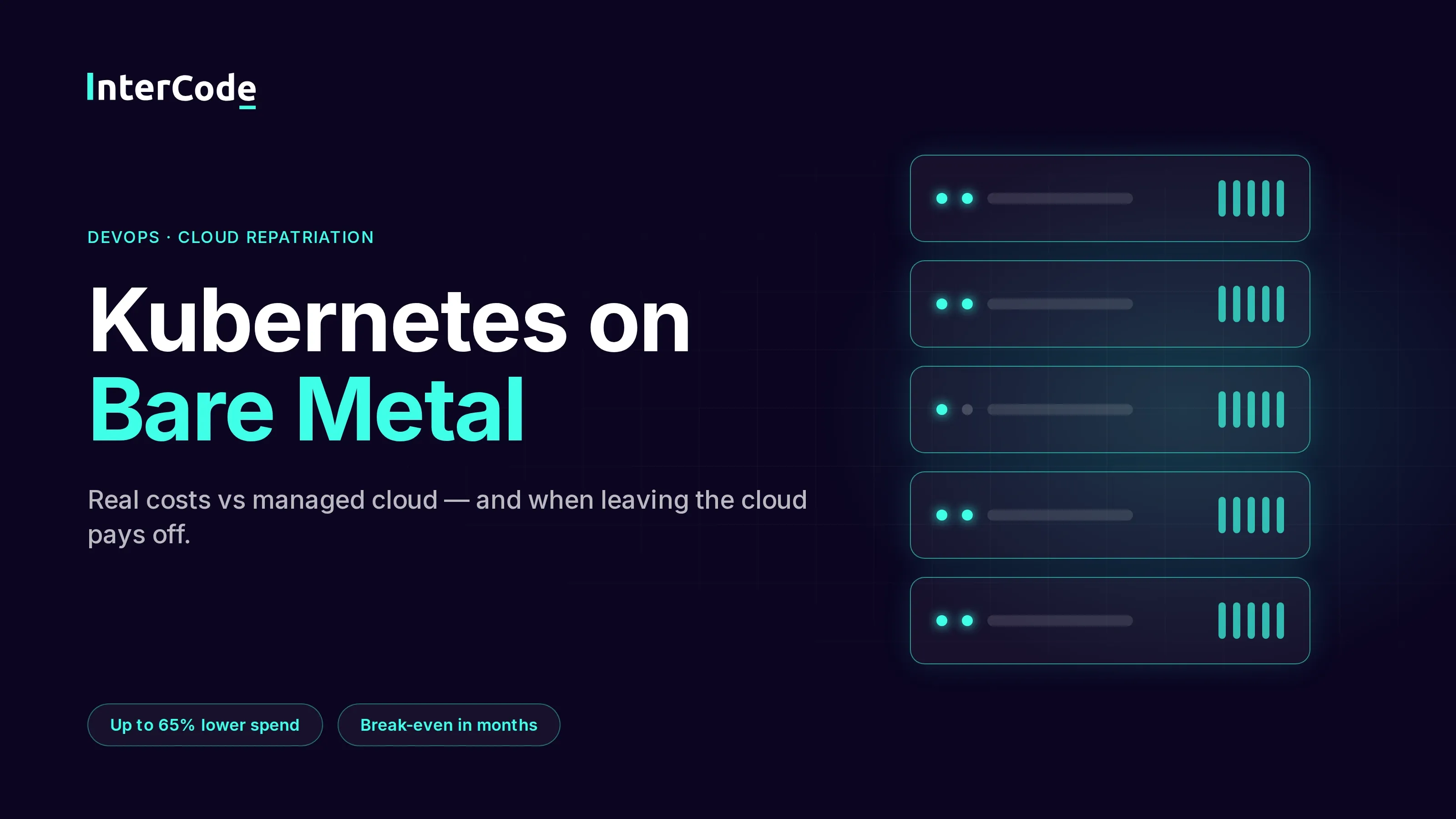
Deploying bare metal Kubernetes can reduce an enterprise's monthly infrastructure expenditure by up to 65%. However, running Kubernetes on bare metal is not universally advantageous. Organizations with unpredictable traffic spikes, early-stage product exploration, or lean engineering teams without dedicated platform operations specialists face operational overhead that quickly erodes those savings. For organizations operating predictable, steady-state workloads at scale, the economic and performance differentials warrant a rigorous evaluation of the self-hosted paradigm.
TL;DR
Migrating steady-state workloads from managed cloud to bare-metal Kubernetes reduces recurring infrastructure spend by 29% to 61% by eliminating hypervisor markups, cross-AZ transit fees, and expensive managed NAT services.
A typical mid-scale repatriation requires 200 to 320 specialized engineering hours, plus a mandatory 30- to 60-day dual-run overlap to safely validate data replication and failover.
Running on dedicated hardware forces internal teams to absorb the responsibility for physical component degradation, manual control plane upgrades, and 24/7 on-call triage without cloud-provider autoscaling or hypervisor abstractions.
Bare metal is ideal for predictable workloads, high egress volumes, and five-figure cloud bills with experienced platform engineers, whereas early-stage MVPs and highly volatile traffic patterns should remain on managed cloud platforms.
What bare metal Kubernetes actually means
Bare metal Kubernetes is the deployment of container orchestration software directly onto physical server hardware without an intermediate hypervisor or virtualization layer. In this architecture, container runtimes interact directly with host operating system kernels, physical central processing units, system memory buses, and solid-state storage arrays.
In conventional cloud configurations, such as Amazon Elastic Kubernetes Service (EKS) running on Elastic Compute Cloud (EC2) or Google Kubernetes Engine (GKE) running on Compute Engine, the Kubernetes node is a virtual machine (VM). The underlying physical hardware is managed by the cloud vendor’s proprietary hypervisor, which slices resources into virtual instances. This virtualization layer:
Abstracts hardware peripherals
Virtualizes network interface cards (vNICs)
Manages CPU time-slicing among multiple tenants
While this abstraction offers provisioning and elastic operational boundaries, it imposes a structural hypervisor tax: measurable CPU cycle theft, memory overhead, and serialized I/O scheduling latency.
Deploying Kubernetes bare metal removes this virtualization layer entirely. The container runtime, such as containerd or CRI-O, and the node agent, the kubelet, execute directly within the host operating system. Networking plugins based on the Container Network Interface (CNI), such as Cilium or Calico, route packets directly across physical network interfaces using extended Berkeley Packet Filters (eBPF) or native host routing tables. They bypass synthetic virtual software switches and software-defined network (SDN) encapsulation. Storage subsystems use non-volatile memory express (NVMe) drives directly through standard kernel block devices, eliminating the latency penalties of virtual storage controllers.
This architecture can operate on owned physical hardware in private colocation data centers or on single-tenant physical servers leased from dedicated hosting providers.
Bare metal vs managed Kubernetes: the real numbers
| Fleet Size | Workload | Managed Hyperscaler (AWS EKS / GKE) | Bare Metal (Hetzner / OVHcloud) | Break-Even | Hyperscaler Operational Trade-Offs | Bare Metal Operational Trade-Offs |
| Small | 3 nodes 24 vCPU / 96 GB RAM 500 GB storage 2 TB egress | $435/mo Control plane: $73 Compute: $276 Storage: $40 NAT/Egress: $46 | $165/mo 3 nodes: $135 Backup: $20 IP/DNS: $10 | Month 3 | Automated control-plane updates, multi-AZ failover, managed storage provisioning | More infrastructure responsibility |
| Mid | 10 nodes 80 vCPU / 320 GB RAM 3 TB NVMe 15 TB egress | $2,840/mo Control plane: $146 Compute: $1,840 Storage: $320 NAT/Egress/ALB: $534 | $790/mo 5 dense nodes: $650 Offsite backup: $60 Redundant routing: $80 | Month 4 | <2-min worker provisioning, KMS integrations, one-click resizing | More manual scaling and infrastructure management |
| Large | 30+ nodes 384+ vCPU / 1.5 TB RAM 20 TB high-IOPS storage 50 TB egress | $11,950/mo Control plane: $219 Compute: $7,200 Provisioned IOPS: $1,850 NAT/Egress/ALB: $2,681 | $2,850/mo 12 EPYC servers: $2,160 Ceph NVMe: $390 Network/transit: $300 | Month 5 | Managed hardware lifecycle, DB point-in-time restores, enterprise IAM federation | Hardware and storage lifecycle become your responsibility |
An important consideration for any infrastructure transition is the total Kubernetes cost. While public hyperscalers promote operational agility, commercial platforms charge substantial premiums across compute, control plane maintenance, data transmission, and supplementary I/O operations. The reality is as follows:
AWS EKS imposes a fixed cluster management fee of $0.10 per hour ($73 per month per cluster) during standard support. Once a Kubernetes minor release reaches the end of standard support (14 months after release), AWS automatically enrolls the cluster in extended support, increasing the control plane charge by 500% to $0.60 per hour ($438 per month per cluster).
Google Cloud similarly charges $0.10 per hour per cluster ($73 per month), although it provides a $74.40 monthly credit covering a single zonal or Autopilot cluster per billing account. Fleets operating separate clusters across development, staging, and production environments accumulate between $219 and $1,314 per month in baseline API server hosting fees before provisioning a single workload container.
Compute instances on hyperscalers reflect significant markups:
An AWS m6i.2xlarge instance providing 8 vCPUs and 32 GB RAM costs approximately $0.384 per hour on-demand, totaling $276.48 per month.
AWS EKS Auto Mode appends a supplementary compute surcharge of approximately 10% to 12% ($0.01152 per hour on an m5.large), increasing expenditures further.
Elastic Block Store (EBS) gp3 storage costs $0.08 to $0.10 per gigabyte-month, provisioned IOPS incur secondary fees, and cloud NAT gateways add $0.045 per hour alongside $0.045 per gigabyte of processed data.
Cross-Availability Zone network traffic incurs a penalty of $0.01 per gigabyte in each direction, and public egress runs between $0.05 and $0.09 per gigabyte.
Conversely, dedicated enterprise servers leased from bare-metal providers such as Hetzner, OVHcloud, or Leaseweb present fundamentally different unit economics. An enterprise-grade dedicated physical node equipped with an AMD EPYC 16-core/32-thread processor, 128 GB of error-correcting code (ECC) DDR5 memory, dual 1.92 TB datacenter NVMe SSDs in hardware RAID 1, and an unmetered 1 Gbps port typically rents for $110 to $160 per month (€95 to €145 per month). The compute density of one such physical machine replaces multiple virtual instances while eliminating data transfer tolls within the cluster local area network.
Even when evaluating cheap managed Kubernetes alternatives such as DigitalOcean Kubernetes (DOKS), where worker nodes run on shared hypervisors starting at $24 per month for basic droplets, multi-tenant resource contention and localized I/O constraints frequently throttle high-throughput systems.
What the migration itself costs
Executing a migration off managed cloud relies on established methodology, typically organized around the classical cloud migration frameworks (Rehosting, Replatforming, Refactoring, Repurchasing, Retiring, or Retaining). When moving in reverse toward dedicated hardware, the process is primarily one of replatforming and refactoring: containerized workloads must be disconnected from proprietary cloud APIs and bound to open, standardized infrastructure interfaces.
Based on InterCode experience, a mid-scale infrastructure migration demands between 200 and 320 specialized engineering hours. InterCode’s consulting rate spans $50 to $99 per hour, representing verifiable market pricing for DevOps consulting services. Applying a median baseline rate of $75 per hour establishes the labor expenditures required across each execution phase.
| Migration Cost Center | One-Off Engineering Investment | Recurring Monthly Operational Cost | Primary Responsibility |
| Discovery, Inventory & Target Topology Design | $3,000 (40 hours at $75/hr) | $0 | Lead Cloud Infrastructure Architect |
| Bare-Metal Provisioning, PXE & OS Hardening | $3,750 (50 hours at $75/hr) | $0 | Senior Systems Engineer |
| Cluster Orchestration & Storage Layer Setup | $4,500 (60 hours at $75/hr) | $0 | Platform / Kubernetes Engineer |
| Database Migration, Replication & Sync Validation | $3,750 (50 hours at $75/hr) | $0 | Database Administrator / Data Engineer |
| CI/CD Pipeline Adaptation & Container Registry Cutover | $2,250 (30 hours at $75/hr) | $0 | DevOps Pipeline Specialist |
| Parallel Dual-Run Infrastructure (60-Day Overlap) | $3,640 (Hyperscaler + Bare-metal run) | $0 | Financial Operations / Cloud Controller |
| Rollback Reserve & Disaster Recovery Validation | $2,500 (Contingency budget) | $0 | Platform Reliability Lead |
| Dedicated Hardware Leases & Colocation Transit | $0 | $1,820 / month | Infrastructure Hosting Vendor |
| Post-Migration Patching & Ongoing Maintenance Retainer | $0 | $1,200 / month (16 hrs/mo at $75/hr) | Managed SRE / Operations Retainer |
| Total Transition Capitalization | $23,390 | $3,020 / month | Enterprise Platform Team |
The dual-run period represents a non-negotiable operational necessity. Running legacy cloud infrastructure concurrently with the newly provisioned bare-metal cluster for 30 to 60 days guarantees that live data replication mechanisms, such as active-passive database streaming or bidirectional message queue bridging, can be validated under production traffic loads without risking service outages. Eliminating or truncating this parallel phase removes the safety net required to conduct an immediate rollback if the bare-metal environment exhibits networking instability, Maximum Transmission Unit (MTU) mismatches, or storage controller latency regression during peak throughput.
Cloud repatriation: who is actually doing this and why
Recent survey metrics from the Cloud Native Computing Foundation (CNCF) demonstrate that while 96% of enterprise organizations use or evaluate Kubernetes, platform teams increasingly distinguish between orchestrator utility and hyperscaler lock-in. Organizations managing steady-state workloads realize infrastructure cost reductions between 29% and 61% through targeted cloud repatriation.
What is cloud repatriation?
Cloud repatriation is the process of moving applications, digital workloads, and organizational data sets from public hyperscale cloud environments back to privately owned data centers, colocation facilities, or dedicated bare-metal server infrastructure. This strategy aims to regain cost predictability, improve raw hardware performance, and maintain sovereignty over physical storage media.
Are people actually moving from cloud storage?

The primary catalyst behind repatriation is the decoupling of infrastructure growth from business revenue. Public clouds operate on utility pricing optimized for variable, bursty demand. When a digital product matures and its baseline resource footprint stabilizes, paying hyperscaler margins on static 24/7 capacity functions as an operational tax. Data transfer tolls represent a persistent friction point: outbound transit fees frequently constitute 15% to 20% of an enterprise’s monthly public cloud billing invoice. Organizations operating content distribution engines, ad-tech platforms, or data-intensive analytics pipelines transfer petabytes of data each month. Paying $0.05 to $0.09 per gigabyte on AWS or GCP becomes economically unjustifiable when bare-metal providers bundle unmetered 10 Gbps connections into fixed server leases.
Workload suitability governs the success of these repatriation initiatives. Transactional relational databases requiring sustained write throughput and deterministic I/O performance benefit directly from local NVMe storage arrays, circumventing cloud-based network-attached block storage throttling and provisioned IOPS surcharges. High-volume ingestion platforms that process continuous telemetry, sensor data, or programmatic bidding requests generate high network ingress and inter-node routing that drive severe cross-AZ billing on cloud providers.
Large in-memory caches demanding terabytes of RAM achieve dramatic unit cost improvements on bare-metal systems. Physical RAM configurations of 512 GB or 1 TB cost a fraction of equivalent cloud memory-optimized instances. Similarly, machine learning inference platforms capture 51% to 72% cost savings by leasing dedicated physical GPU hosts rather than paying hourly cloud rates.
Addressing concerns over whether organizations are broadly abandoning cloud storage reveals a more nuanced reality. Companies are not entirely discarding hyperscaler object stores, but they are repatriating primary, high-throughput analytics data and backup archives to private S3-compatible Ceph or MinIO deployments to eliminate petabyte-scale egress fees.
Hyperscalers continue to host massive internet-facing platforms. For example, Netflix famously relies on AWS for global streaming infrastructure while deploying proprietary orchestration engines such as Titus to manage compute density. Conversely, workloads that should never leave public hyperscalers include transient development sandboxes, seasonal burst pipelines that sit idle for weeks, and products that rely heavily on proprietary cloud integrations (e.g., AWS DynamoDB, Step Functions, or Google BigQuery) where rewriting software architectures would eclipse multi-year hosting savings.
Cloud exit strategy: what you give up
Opting out of managed cloud platforms requires accepting operational responsibilities that managed vendors conceal behind automated abstractions. A successful infrastructure strategy requires acknowledging what is surrendered when adopting bare-metal Kubernetes.
| Functional Capability | Managed Hyperscaler (AWS EKS / GKE) | Bare-Metal Kubernetes | Operational Impact & Risk Profile |
| Control Plane Lifecycle | Managed by cloud provider; automated control-plane repair, multi-AZ distribution, and rolling updates. | Maintained internally; manual etcd clustering, quorum recovery, TLS management, and sequential minor-version upgrades. | High risk of cluster outage during version transitions if etcd state becomes inconsistent or API deprecations are mismanaged. |
| Compute Elasticity & Node Provisioning | Dynamic horizontal node autoscaling within 45 to 90 seconds via Karpenter or Cluster Autoscaler. | Constrained by physical hardware inventory; new server procurement takes hours to weeks. | Unanticipated load spikes can exhaust compute capacity, forcing deliberate over-provisioning of static hardware headroom. |
| Physical Hardware Maintenance | Fully abstracted; transparent host migration upon hypervisor or physical component degradation. | Managed directly; on-call triage for memory bit flips, NVMe drive failures, bad cables, and power supply unit (PSU) issues. | Degraded hardware requires manual cordoning, draining, physical replacement RMA tracking, and cluster rebalancing. |
| Operational & On-Call Overhead | Platform SLA covered by vendor up to the hypervisor boundary; smaller SRE staffing requirements. | Comprehensive full-stack liability from physical motherboard firmware up to container orchestration. | Requires specialized 24/7 systems operations coverage; labor costs can erase hosting savings if scale is insufficient. |
Managed control plane and upgrades
In managed offerings like AWS EKS or GKE, the cloud provider assumes operational responsibility for the Kubernetes control plane. The API server, the scheduler, the controller manager, and the underlying etcd key-value datastore are deployed across isolated availability zones with automated continuous backups, multi-master replication, and health monitoring.
On bare metal, the platform engineering team solely owns the control-plane architecture. A production cluster demands a minimum of three dedicated control-plane nodes configured in an odd-numbered quorum to prevent split-brain states in etcd. Managing etcd requires implementing:
Explicit snapshot scheduling
Defragmentation routines
Disaster recovery procedures
Furthermore, Kubernetes issues three minor releases annually. Upgrading a bare-metal control plane involves:
Manually coordinating upgrades across kubelet, kubeadm, and control-plane binaries
Managing Container Network Interface compatibility
Updating internal cryptographic certificates before their 365-day expiration
Testing for deprecated API versions
A misconfigured control-plane upgrade can freeze cluster state or partition the API server, halting all application scheduling.
Autoscaling
Elastic autoscaling in public clouds operates via integrated cloud-provider APIs. Technologies like Karpenter on AWS monitor pending pods and provision right-sized EC2 worker nodes that boot, initialize, join the cluster, and accept container workloads in less than two minutes.
On bare metal, autoscaling is structurally constrained by physical inventory. While tools like Cluster API Provider Bring-Your-Own-Host (BYOH) or Canonical MAAS (Metal as a Service) automate operating system imaging across existing physical chassis, they cannot provision unpurchased silicon. Commissioning an additional bare-metal server from a hosting provider requires:
API provisioning
Hardware inventory checks
Automated network trunking
PXE network booting
Baseline operating system installation
If a company houses its own hardware in a colocation facility, scaling capacity involves physical server procurement, rack mounting, cabling, and switch port configuration, carrying lead times of weeks. As a result, bare-metal clusters must maintain a permanent buffer of unutilized static capacity (typically 20% to 30%) to absorb traffic surges without degrading service.
Hardware failure is now your problem
Public cloud architectures create an illusion of hardware immortality. When a physical server supporting an EC2 or Compute Engine instance experiences an uncorrectable ECC memory error or a failing motherboard, the hypervisor isolates the machine, transparently migrates the virtual instance, or restarts the VM on an alternate hypervisor host within seconds.
On bare metal, hardware failures fall directly on internal engineering operations:
Solid-state drives degrade and transition to read-only states.
RAM modules experience uncorrectable multi-bit ECC errors that trigger kernel panics.
Top-of-rack switch ports drop packets.
Power supply units suffer electrical failure.
When a physical bare-metal host crashes, every container, database instance, and routing proxy hosted on that individual chassis terminates immediately. The platform team must:
Deploy resilient storage replication such as Ceph or Longhorn.
Configure automated node fencing mechanisms.
Coordinate Return Merchandise Authorization (RMA) hardware replacements with data centers.
Oversee physical drive rebuilding without dropping cluster quorum.
By the way, we recommend you read our article “What Is a Forward-Deployed Engineer and When to Hire One?”
The on-call cost nobody budgets
The most prevalent financial miscalculation in infrastructure planning is the omission of systems engineering labor from total cost calculations. When an enterprise offloads infrastructure to AWS or Google Cloud, the hyperscaler’s massive site reliability engineering organization monitors:
Physical facilities
Power infrastructure
Hypervisor maintenance
Physical hardware lifecycles
Migrating to bare metal moves the responsibility for 24/7 physical infrastructure health to internal staff. To sustain a 24/7/365 production on-call rotation without engineer burnout requires a minimum of four to five engineers capable of debugging low-level Linux kernel parameters, BGP network routing anomalies, CNI eBPF tables, and storage controller timeouts. Comprehensive Kubernetes cost monitoring must account for these operational expenses alongside tooling licenses.
Given that senior site reliability engineers command baseline annual salaries between $140,000 and $190,000 in competitive markets, building an internal operational rotation can easily add $600,000 or more in overhead. Unless an organization already employs platform engineers or contracts a dedicated managed DevOps partner to maintain operational health, hardware savings can be rapidly eclipsed by internal staffing expenses.
When bare metal wins and when it does not
The decision to run container orchestration on dedicated silicon versus managed public cloud must be evaluated against many factors.
| Operational & Workload Scenario | Strategic Verdict | Architectural & Financial Rationale | Prescribed Alternative Action |
| Predictable, Steady Compute Loads | Bare Metal Wins | High sustained CPU/RAM utilization avoids the 300% to 400% elasticity markup charged by hyperscalers for dynamic capacity. | Deploy dedicated bare-metal servers running K3s or kubeadm with local NVMe caching. |
| Spiky, Highly Volatile Traffic Spikes | Managed Cloud Wins | Physical hardware cannot be provisioned fast enough to absorb sudden, unpredictable 10x traffic surges without immense static idle overhead. | Retain workloads on AWS EKS or GKE Autopilot using Karpenter and Spot instance pools. |
| Small Engineering Teams (No Dedicated SRE) | Managed Cloud Wins | The operational burden of managing physical storage arrays, etcd backups, and kernel patching diverts focus from software delivery. | Use low-friction managed providers (e.g., DigitalOcean Kubernetes, Civo) or stay on AWS EKS. |
| Strict Data Sovereignty & Hardware Isolation | Bare Metal Wins | Fulfills regulatory mandates requiring physical disk destruction tracking, single-tenant hardware isolation, and sovereign boundary compliance. | Deploy bare-metal clusters in sovereign regional data centers with full LUKS disk encryption. |
| Early-Stage MVPs & Startups | Managed Cloud Wins | Product-market fit experimentation demands platform agility, rapid prototyping, and turnkey managed databases over unit economics. | Build on managed container runtimes (such as AWS ECS, Google Cloud Run, or Fly.io). |
| Cloud Spend Exceeding $20,000 / month | Bare Metal Wins | At this spending threshold, compute and egress differentials yield annual savings ($120,000+) that easily fund specialized engineering retainers. | Formulate a multi-phase cloud exit strategy to transition data and compute to bare metal. |
Kubernetes as the bridge between public and private cloud
Kubernetes serves as the architectural enabler of modern cloud exits. By providing a consistent abstraction layer over disparate physical and virtual environments, Kubernetes eliminates cloud lock-in and normalizes software operations.
Kubernetes makes workload migration easier
Kubernetes handles container scheduling, service discovery, persistent storage mounts, and ingress routing. This is why migrating a containerized microservice from public cloud to private infrastructure involves 3 straightforward steps:
Provisioning bare-metal physical nodes and joining them to the private Kubernetes control plane.
Deploying application workloads onto the private node pool using standard GitOps pipelines.
Updating edge load balancers or DNS routing records to direct incoming traffic to the private infrastructure ingress endpoints.
We also recommend you read our article “Operating the Autonomous Software Factory: Scaling Enterprise SDLC in 2027”
One deployment model across different infrastructure
Whether running on AWS EKS, Google GKE, Azure AKS, or a bare-metal Kubernetes cluster inside a colocation cabinet, developer deployment workflows remain identical. Container manifests, Helm charts, and CI/CD pipelines require no modification. This portability allows platform teams to migrate workloads across cloud providers and private infrastructure based on financial efficiency.
Containerization reduces infrastructure lock-in
Standardizing application architectures on open-source, containerized components decouples software from proprietary public cloud tools. Replacing proprietary PaaS products with containerized equivalents ensures cross-platform portability.
| Proprietary Cloud PaaS Service | Portable Open-Source Equivalent | Private Infrastructure Deployment Stack |
| AWS DynamoDB / GCP Spanner | PostgreSQL / CockroachDB | Kubernetes StatefulSets with Longhorn / Ceph storage |
| AWS SQS / GCP Pub/Sub | RabbitMQ / Apache Kafka | Strimzi Kafka Operator running inside Kubernetes |
| AWS ElastiCache | Redis / Dragonfly | Containerized Redis deployed on local host memory |
| AWS EKS Managed Control Plane | K3s / RKE2 / Upstream K8s | Bare-metal Kubernetes control plane with MetalLB load balancing |
| AWS CloudWatch Logging | Grafana Loki / VictoriaMetrics | Containerized telemetry stack running on local NVMe arrays |
Kubernetes doesn't eliminate operational costs
While Kubernetes abstracts infrastructure for application developers, it transfers operational responsibility to platform engineering teams. Running Kubernetes on bare metal requires active management of platform components that public cloud providers manage behind the scenes:
Control Plane Maintenance. Ensuring high availability, etcd data store backups, security patching, and zero-downtime cluster upgrades.
Bare-Metal CNI & Networking. Configuring eBPF routing (Cilium), Layer 2/3 load balancing (MetalLB), and network security policies across physical hardware switches.
Storage Subsystem Management. Operating distributed software-defined storage (Longhorn, Ceph) across physical NVMe drives, managing disk failures, and rebalancing storage pools.
Host Security & Compliance. Operating physical facility access controls, patching host operating systems, managing firewalls, and maintaining compliance audits.
Disaster Recovery. Managing off-site backup pipelines, cluster state snapshots, and failover operations across data center locations.
We also recommend you read our article “How Much Does Fintech App Development Cost? Budget Tiers, Compliance, and Vendor Fees”
If you decide to move: what to check first
Before committing capital to an infrastructure migration, you must conduct an operational audit to mitigate cutover risk. Executing these technical checks validates platform readiness and prevents production outages:
Measure Steady-State vs. Peak Resource Utilization. Historical 90-day utilization metrics should be evaluated to isolate baseline CPU, memory, and disk consumption patterns. Workloads where peak burst demand exceeds steady-state baseline by less than 2.5:1 represent viable candidates for fixed bare-metal hardware.
Audit Data Egress and Network Topologies. Calculate the exact monthly volume of data transferred out of the cloud environment to external consumers, third-party APIs, and geographically separated services. If outbound transit and NAT processing fees surpass $1,500 per month, shifting to unmetered bare-metal transit lines delivers immediate fiscal relief.
Catalogue Cloud-Proprietary Service Dependencies. Every dependency on proprietary cloud APIs (such as Amazon DynamoDB, SQS, AWS KMS, or GCP Pub/Sub) must be mapped and refactored toward open-source primitives (such as ScyllaDB, RabbitMQ, HashiCorp Vault, or NATS) before container runtimes are relocated.
Establish the Software-Defined Storage Architecture. Applications requiring stateful persistent storage across physical hosts necessitate a distributed block storage engine such as Ceph or Longhorn. These storage fabrics require dedicated physical storage nodes and 10 Gbps private network interfaces to prevent I/O starvation.
Verify Hardware Remote Management Capabilities. Ensure that the hosting provider or colocation facility exposes out-of-band management protocols. We mean Intelligent Platform Management Interface (IPMI), Baseboard Management Controller (BMC) access, and automated PXE operating system imaging APIs to permit headless operational recovery.
Audit Engineering Team Operational Readiness. The internal engineering staff must possess verified expertise in Linux kernel tuning, systemd process management, eBPF network troubleshooting, and etcd disaster recovery. If these skills are absent, engaging an external platform partner like InterCode is necessary prior to production cutover.
Formulate a Phased Cloud Exit Strategy. Transition plans must incorporate a phased rollback design. Traffic must be redirected back to the legacy cloud platform via weighted DNS routing within minutes if unexpected latency regressions occur during the initial 30 days of production execution.
By the way, if you are in need of AI agent orchestration with OpenClaw, we can also help you implement that project.
InterCode is a reliable partner for migrating to Kubernetes on bare metal
InterCode provides DevOps consulting services. You can partner with InterCode to design, execute, and maintain bare-metal topologies. Our engineers help enterprises:
Audit TCO and workload suitability. We analyze 90-day resource utilization, network egress profiles, and cloud-proprietary dependencies to calculate verifiable break-even points before committing capital.
Design resilient bare-metal architectures. We engineer high-availability Kubernetes and K3s clusters with enterprise-grade storage fabrics (such as Ceph or Longhorn) and deterministic BGP network routing.
Execute zero-downtime migrations. We implement phased, dual-run cloud migration services with active-passive replication and automated rollback safeguards, modeled on proven production deployments like our Localyser migration.
Provide ongoing SRE and maintenance retainers. We deliver routine Linux kernel patching, automated etcd backup validation, upstream Kubernetes version upgrades, Kubernetes cost reduction ideas, and SLA-backed operational support.
If your organization is spending five figures monthly on AWS, Google Cloud, or Azure and evaluating a cloud exit strategy, explore our cloud migration services.
 43 likes