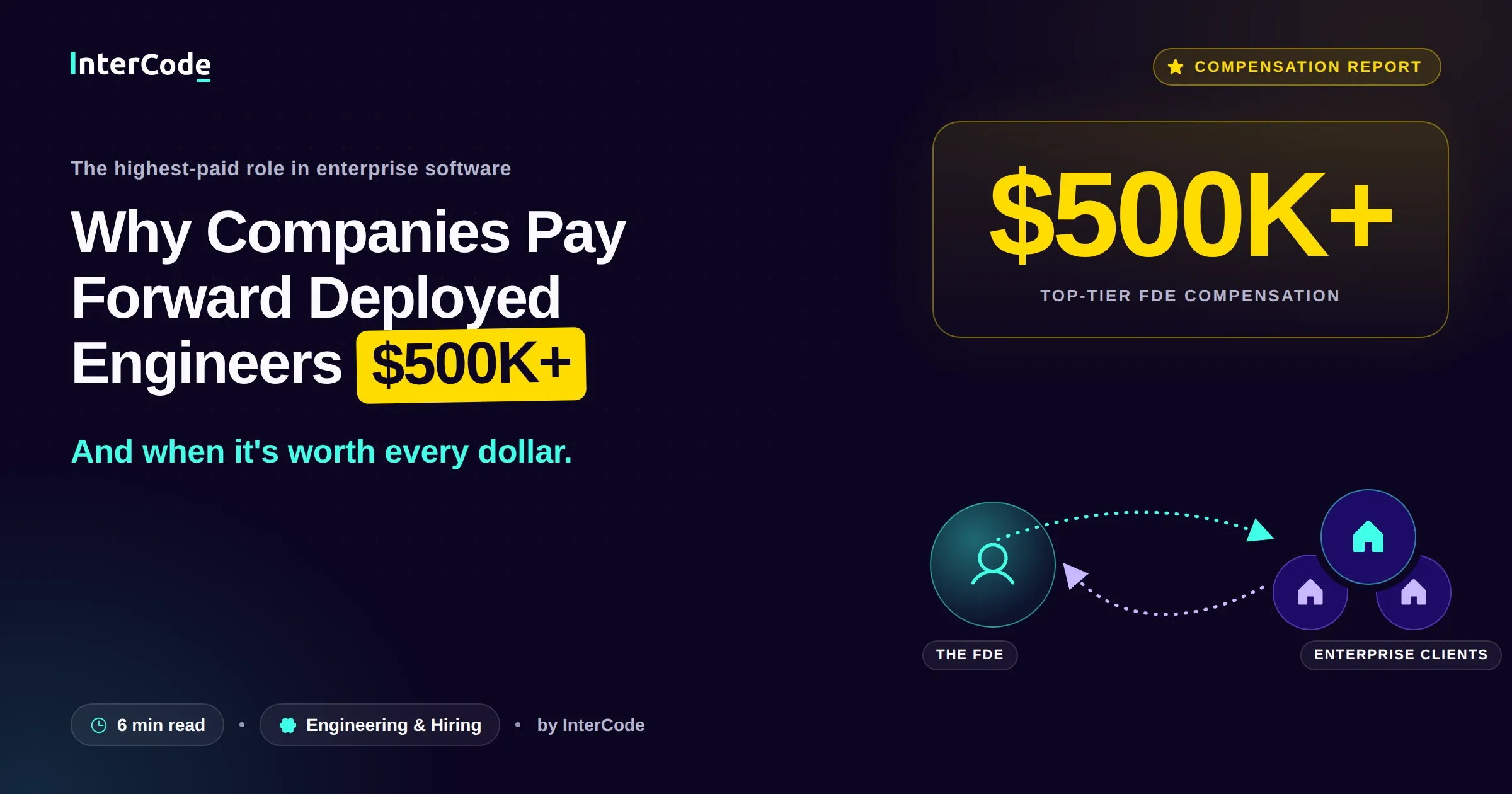
What Is a Forward-Deployed Engineer and When to Hire One?
As software vendors move upmarket to secure high-value contracts within the world's most complex institutions, the traditional self-serve delivery model consistently fractures. This friction is particularly acute in deployments involving advanced analytics platforms and LLMs. While a multi-tenant cloud application may perform flawlessly in a vendor’s sandboxed environment, its implementation in an active corporate ecosystem is often stalled by a chaotic reality of:
Undocumented legacy APIs
Fragmented database schemas
Strict compliance barriers
Unstructured data pipelines
In traditional software distribution, engineering talent remains isolated within a centralized corporate research and development laboratory, insulated from the friction of daily customer operations. In contrast, a forward-deployed engineering talent posture places technical resources directly within the client’s physical or operational perimeter.
TL;DR
A forward-deployed engineer (FDE) is a customer-embedded engineer who writes production code, integrates systems, and solves technical problems directly within a client’s environment.
Unlike a solutions engineer, who primarily supports the pre-sales process, an FDE works after the deal is signed and is responsible for getting complex deployments into production.
FDEs are particularly valuable for enterprise AI, defense, healthcare, finance, and other highly regulated industries where legacy systems, fragmented data, security requirements, and custom integrations make standard SaaS deployment difficult.
A strong FDE combines software engineering, data engineering, systems integration, troubleshooting, and customer-facing communication skills.
Startups should consider hiring a forward-deployed engineer when complex customer requirements begin blocking sales, deployment, or expansion.
The FDE model makes the most sense for high-value contracts where the technical complexity of implementation justifies the cost of specialized engineering support.
The main risks include high costs, customer-specific technical debt, unclear ownership, knowledge concentration, security exposure, and long-term dependency on external engineers.
Companies can use an external partner such as InterCode to access embedded engineering expertise without committing to the full cost and overhead of building an FDE team.
What Is a Forward-Deployed Engineer?
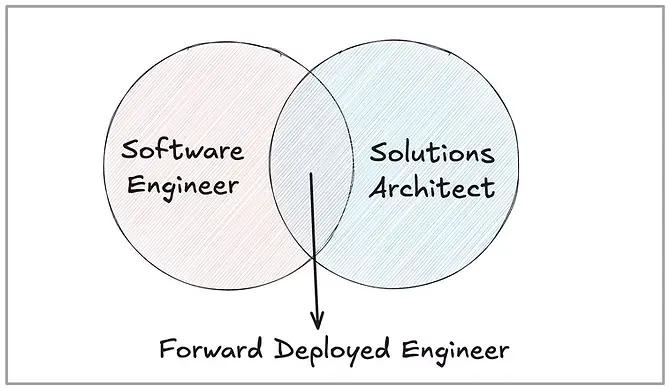
A forward-deployed engineer is a customer-embedded engineer working within client workspaces to write production code and configure systems. Unlike standard developers, every assigned forward-deployed engineer has full code accountability from discovery to long-term operations. But what does a forward-deployed engineer do on a daily basis? They debug data pipelines, write custom APIs, and sit in operational meetings with client users.
What does a forward-deployed engineer do when a system crashes? They act immediately. They do not just file a ticket. They write a patch on site and coordinate with the main product team. They are technical generalists who write Python, Go, or SQL with ease.
The forward-deployed engineer role originated around 2010 at Palantir Technologies. Palantir co-founder Alex Karp compared these engineers to waiters in renowned French restaurants. These waiters understand how the kitchen operates as well as the cooks, allowing them to recommend custom pairings or tailor dishes to a guest's specific taste. In the same way, the embedded developer builds the last mile of a product to make it function in production.
How Does the Forward-Deployed Engineer Model Work Within Palantir Technologies?
Within the pioneer of this model, Palantir Technologies, the operational structure is divided into three distinct human-capital roles:
Echos. Echos function as deployment strategists. They work at the intersection of the customer organization and Palantir’s technical teams.
Deltas. Deltas (the internal designation for field-embedded developers) are responsible for localized platform customization, data modeling, and physical integration.
Devs. Devs operate as the centralized core platform architects. They focus on foundational product development.
The developer operates in lockstep with a deployment strategist who manages organizational politics and stakeholders. This dual-role framework forms an agile unit capable of securing rapid operational adoption while insulating technical assets from client-side bureaucracy.
Key Skills Required for a Forward-Deployed Engineer to Bring Great ROI
An elite forward deployment engineer must be comfortable operating in grey areas where requirements are incomplete. These individuals must pass the same coding tests as standard backend developers, yet they must also tolerate extreme operational friction. They need the profile of a scrappy startup CTO: technically deep, comfortable with ambiguity, and capable of navigating broken data environments. We think the ROI on a professional services team depends entirely on these technical and commercial capabilities.
| Capability | Primary Language or Tool | Business Value |
| Data Engineering | SQL, Python | Builds data pipelines and schema connections |
| Systems Engineering | C++, Java | Optimizes backend performance and client APIs |
| Web Development | JavaScript, React | Crafts client-facing tools and user interfaces |
| Business Discovery | Stakeholder interviews | Uncovers operational bottlenecks and maps workflows |
Forward Deployed Engineer vs Solutions Engineer
When building out a customer-facing technical team, you must understand the differences between a solutions engineer vs forward deployed engineer. These two roles function in entirely distinct phases of the customer lifecycle. We think confusing them is a recipe for project failure.
So, what is the gap in solutions engineer vs forward deployed engineer responsibilities? A solutions engineer owns the pre-sales process. He or she is building lightweight prototypes and running high-level technical demonstrations to win the deal. Once the contract is signed, their job is done. Conversely, the forward-deployed engineer writes production-grade code that runs inside the client's actual system. They take the product past the demo phase and handle messy data pipelines and legacy system blockers on-site.
A forward-deployed engineer vs solutions engineer model comparison shows a massive difference in technical depth. A pre-sales professional is focused on winning the account, whereas an embedded builder is judged on whether the system actually goes live and delivers operational value.
Why Is the FDE Model Gaining Traction in Enterprise AI Tech and Professional Services?
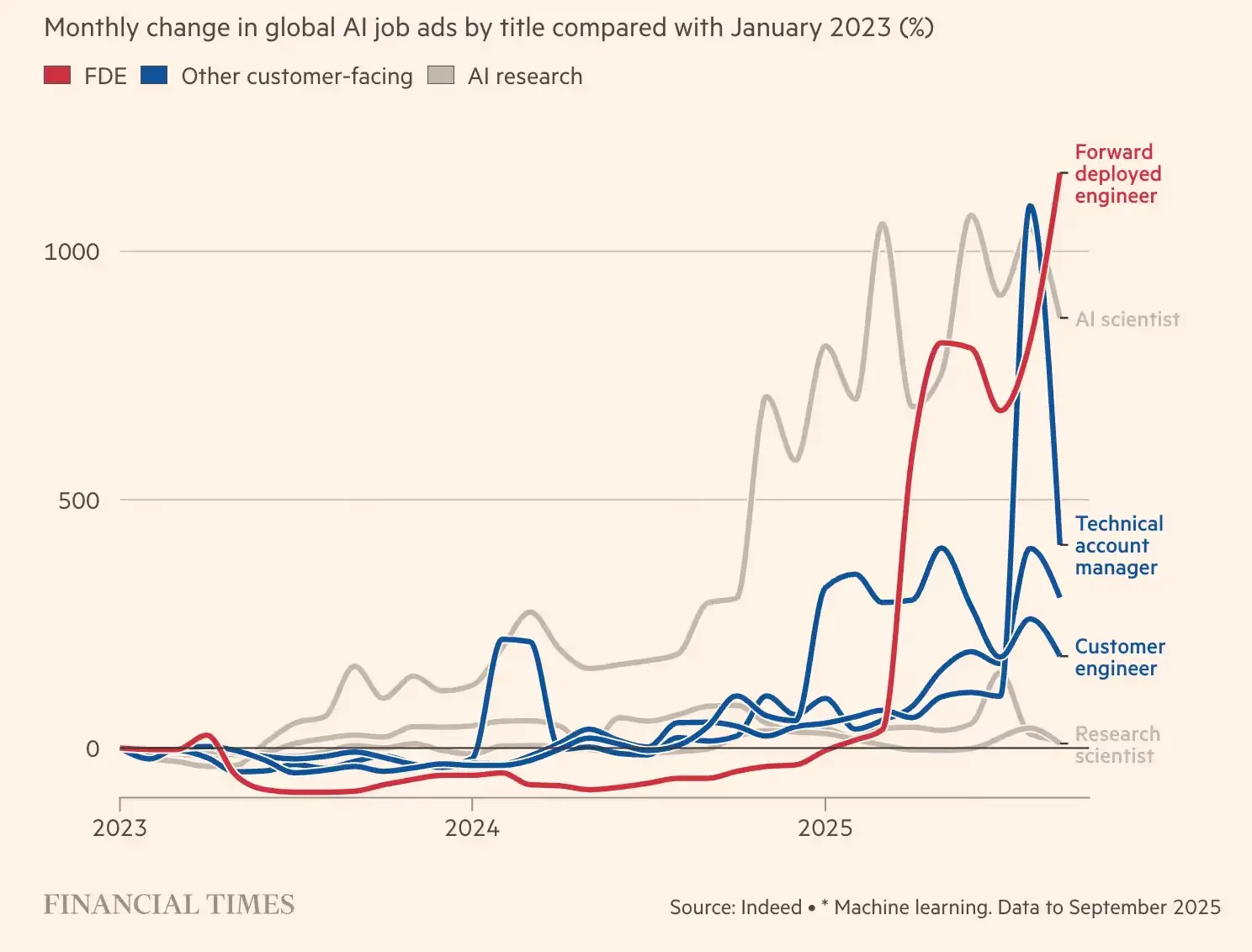
We think the rise of enterprise generative AI drives the sudden interest in the FDE model. Many startups now employ forward-deployed engineers to manage client deployments. This shift occurs because the primary bottleneck in enterprise AI is pipeline coupling, not the intelligence of the models.
Connecting a model to sensitive corporate financial records or healthcare data requires custom pipelines, security gates, and evaluation systems. This is why top-tier AI firms are recruiting forward-deployed engineers to bridge the execution gap. They translate model outputs into tangible business performance.
At the same time, professional services firms are moving away from traditional slide decks toward functional code. Why? We see clients demand working systems that prove immediate value. And this is the main reason for moving.
When Do You Actually Need an FDE?
For CEOs, CTOs, and investors, deciding when to deploy an embedded engineer is a critical decision. This strategy works best when deal sizes are massive and legacy data environments are highly chaotic.
| Indicator | Deploy Embedded Engineers | Stick to Standard Support |
|---|---|---|
| Contract Value (ACV) | High ($150,000 to $1M+) | Low to Medium (Under $50,000) |
| Data Environment | Chaotic databases, legacy schemas | Clean, standardized APIs |
| Regulatory Requirements | High (Finance, Healthcare, Defense) | Low (General productivity tools) |
| Delivery Complexity | High (Requires custom models, pipelines) | Low (Out-of-the-box installation) |
When Should a Startup Hire a Forward-Deployed Engineer?
It is a matter of timing. According to our experience, a startup should hire a forward-deployed engineer when the sales pipeline is blocked by complex client demands. These experts remove engineering roadblocks. If clients are asking for custom data pipelines, these professionals can clear those blocks quickly.
Forward-deployed engineers in the context of modern AI mean shipping models is only half the battle. The other half is getting those models connected to old databases. You can think of them as a tactical CTO for the client's specific setup.
Challenges of Working With an FDE
Hiring field engineering resources can provide enterprises with highly specialized technical expertise, but it also introduces several operational challenges that companies must manage carefully:
The first challenge is cost. FDEs are typically highly experienced engineers with specialized technical skills, making their involvement significantly more expensive than conventional implementation or IT resources. When an enterprise requires an FDE to work closely with its teams for several months, the total cost can become substantial. Organizations therefore need to ensure that the expected operational, financial, or strategic value of the deployment justifies the investment.
Second, companies can fall into the feature garage trap. Because FDEs are capable of building highly customized solutions, internal teams may continuously request one-off scripts, integrations, dashboards, or workflow modifications. Over time, this can create a growing layer of customer-specific technology that becomes difficult to maintain and creates dependency on the FDE. Enterprises should therefore distinguish between temporary implementation work and capabilities that should ultimately become part of the vendor's core product.
Organizational integration is another challenge. FDEs frequently operate between the vendor's engineering organization and the customer's internal teams. If responsibilities are not clearly defined, they can overlap with internal developers, architects, data engineers, or IT teams. Establishing clear ownership, communication channels, and escalation processes is essential to prevent duplicated work and ensure that the FDE complements rather than replaces internal technical capabilities.
Knowledge retention can also become a concern. FDEs often develop an unusually deep understanding of the customer's infrastructure, data, workflows, and business processes. If that knowledge remains concentrated in one or two individuals, the customer can become dependent on specific engineers. Organizations should therefore require sufficient documentation, knowledge transfer, and internal enablement throughout the engagement.
Security and governance present additional complexity. FDEs may require access to sensitive data, production environments, internal systems, and proprietary infrastructure. Customers must establish appropriate access controls, monitoring, data-isolation policies, and offboarding procedures while still giving the engineers enough access to perform their work effectively.
Finally, FDE engagements can create organizational dependency. This happens if the customer begins relying on external engineers for capabilities that should ultimately reside within its own technical organization. The goal should not be to permanently outsource critical technical knowledge, but to use the FDE as an accelerator: helping internal teams deploy the platform, solve complex integration problems, establish best practices, and eventually operate the resulting system independently.
The central challenge for a company hiring FDEs is therefore maximizing the value of deep technical engagement without creating high cost, technical debt, or vendor dependency.
Comparative Analysis of Post-Sales and Engineering Roles
To fully understand the organizational value of field-embedded technical personnel, it is vital to contrast them with other customer-facing and engineering roles.
| Operational Dimension | Field-Embedded Developer (FDE / FDSE) | Core Software Engineer (SWE) | Solutions Architect (Pre-Sales SE) | Implementation Consultant |
| Primary Structural Alignment | Single customer environment and workflows | Foundational platform architecture and multi-tenant reusability | Sales pipeline validation and proof-of-concept development | Project timeline management, checklists, and basic setup |
| Production Code Authority | Yes; extends platform capabilities and writes custom code | Yes; develops and optimizes core platform features | Minimal; constructs temporary demonstrations and scoping blueprints | No; confined entirely to declarative software configurations |
| Customer Proximity | Highly embedded (frequently on-site with client teams) | Low (isolated behind internal ticketing systems) | Moderate (focused on technical buyers and sales cycles) | High (focused on business user onboarding and coordination) |
| Integration Focus | Unifying legacy schemas, data cleansing, and API mapping | Scaling distributed microservices and infrastructure stability | High-level system scoping and contract validation | Tracking implementation checklists and coordinating schedules |
| Core Success Metric | Direct customer business outcomes and long-term retention | Feature velocity, code coverage, and platform uptime | Deal closure rates and technical scoping accuracy | On-time project delivery and onboarding satisfaction |
Key Compensation Models for Forward-Deployed Engineers
Providing embedded technical services requires a deep financial commitment. The data below shows typical industry compensation ranges for these specialized, customer-facing technical professionals.
| Role or Employer | Compensation Range (Total) | Key Structural Driver |
| Palantir FDSE (FDE) | $189k – $431k (Median: $215k) | Cash base with standard equity |
| OpenAI or Anthropic FDE | $350k – $550k | Heavy premium equity grants |
| Palantir Deployment Strategist | $110k – $170k | Operational focus rather than engineering |
| Staff-Level FDE (Big Tech) | $630k+ | High strategic ownership of enterprise deals |
| InterCode Embedded FDE | $85k – $120k | Flexible contract model, global technical talent |
Why InterCode Is the Optimal Forward Deployed Engineering Partner

Every week an enterprise deal sits stuck at implementation is a week of lost revenue, and a hiring process for a single FDE can take months you don't have. InterCode closes that gap.
We deploy vetted forward-deployed engineers who can be in a client meeting within days, not quarters — engineers who already know how to walk into a messy, unfamiliar system and make it work under pressure. No lengthy recruiting cycle. No six-figure retained-search fee. No gamble on a hire who looks great on paper but has never actually sat across from a client mid-outage.
Whether you need one engineer to rescue a single stalled account or a full embedded team to support your entire enterprise book, InterCode scales with you — on a flexible contract model, at a fraction of the cost of building an internal FDE org from scratch. You keep the revenue-saving speed of a forward-deployed team without carrying its full-time overhead.
Ready to stop losing deals at the finish line? Talk to InterCode about getting a forward-deployed engineer in front of your client this week.
Conclusion
The integration of embedded engineering units represents a highly effective mechanism for deploying data-intensive software platforms and generative AI technologies within the most demanding enterprise environments. For enterprise technology firms looking to construct, scale, or optimize an active forward-deployed engineering capability, we recommend:
- Designate a clear separation of labor between pre-sales technical scoping, relationship management, and post-sales custom implementation.
- Establish tight, automated programmatic synchronization between front-line developers and core platform R&D teams to ensure client-specific discoveries are systematically baked back into the multi-tenant core platform.
- Treat the embedded technical division as a high-margin productization strategy rather than a low-margin professional services cost center, aligning hiring processes and equity-heavy compensation structures to attract elite engineering talent.
- Implement dedicated professional services automation and delivery infrastructure to eliminate administrative friction, maximizing the time forward-deployed developers spend on active systems programming.
- Structure core platform software architectures with robust API boundaries, dynamic ontologies, and decoupled extension layers to enable rapid front-line customization without accumulating technical debt in the core codebase.
Ultimately, the competitive advantage of the forward-deployed engineering model lies in its ability to close the gap between a general-purpose software platform and the highly specific operational realities of individual enterprises. The strongest organizations position forward-deployed engineers as a strategic interface between customers, deployment environments, and the core product organization.
 24 likes