How Much Does It Cost to Build an AI Agent? Real 2026 Pricing
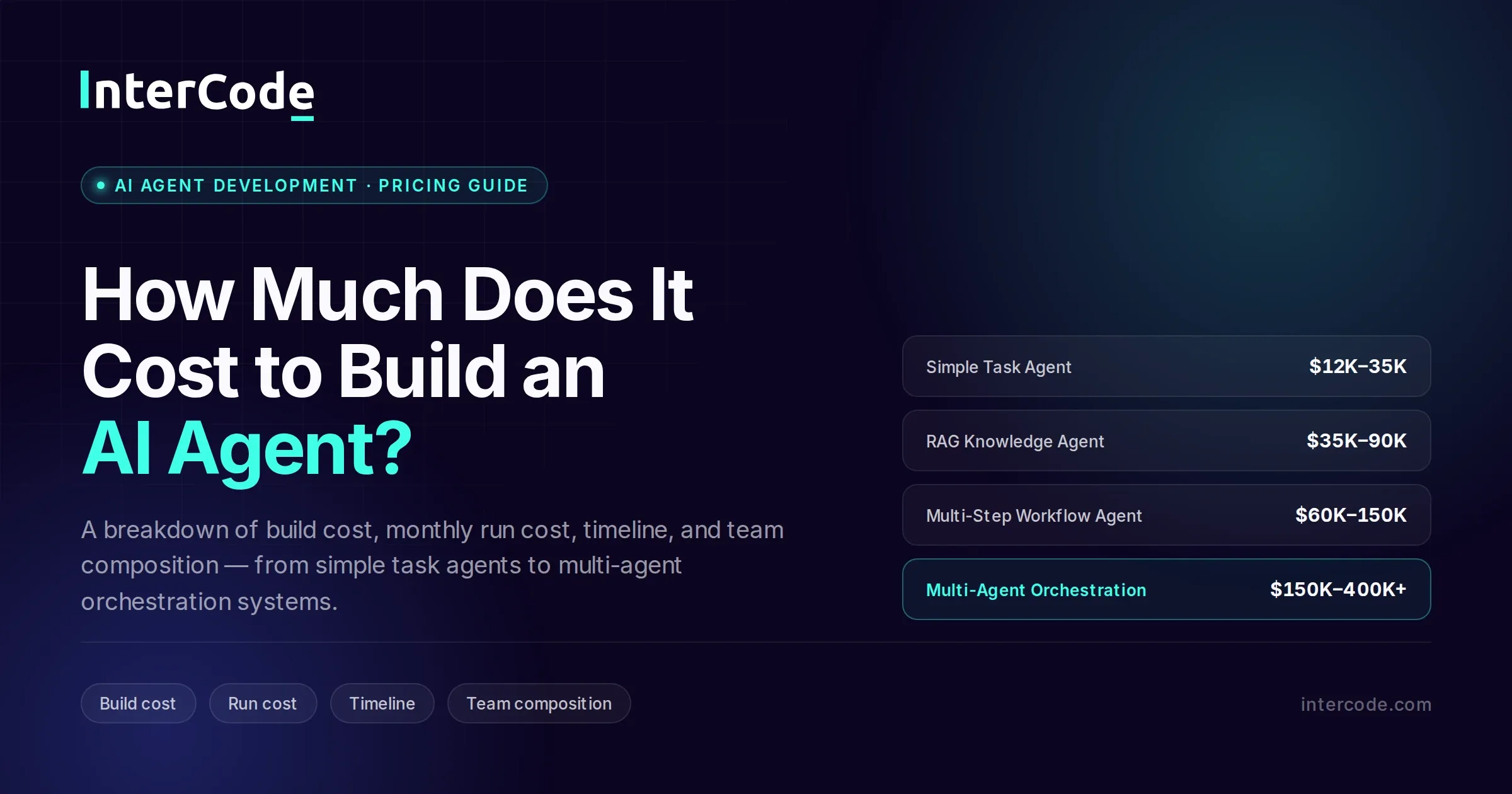
Building an AI agent costs between $12,000 and $400,000, and most business deployments land between $40,000 and $120,000. The primary driver behind this 33x spread is architectural. Pricing changes as a system evolves from a single-prompt script into an autonomous, stateful multi-agent network integrated with core enterprise systems. This guide provides an objective AI development cost framework for sizing development budgets, evaluating vendor proposals, and projecting multi-year operational expenditures.
What an AI Agent Costs at a Glance
The capital required to build an artificial intelligence agent depends on:
Level of reasoning required;
Statefulness of the context window;
Number of tool connections;
Concurrency of operational workflows.
While single-function automation scripts can be deployed rapidly by small engineering teams, distributed multi-agent systems require cross-functional teams of ML specialists, systems architects, and security engineers.
| Agent Architecture Tier | Build Cost Range | Monthly Operational Run Cost | Delivery Timeline | Core Engineering Team Composition |
| Simple Task Agent | $12,000 – $35,000 | $200 – $1,000 | 3 – 6 weeks | 1 AI/ML Engineer, 0.5 QA Engineer |
| RAG Knowledge Agent | $35,000 – $90,000 | $1,000 – $4,500 | 6 – 10 weeks | 1 AI Specialist, 1 Data/Backend Engineer, 0.5 QA Engineer |
| Multi-Step Workflow Agent | $60,000 – $150,000 | $2,500 – $8,000 | 8 – 14 weeks | 2 AI Engineers, 1 Backend Systems Architect, 0.5 PM, 0.5 QA Engineer |
| Multi-Agent Orchestration System | $150,000 – $400,000+ | $6,000 – $25,000+ | 12 – 24 weeks | 2–3 Senior AI Engineers, 1 Distributed Systems Engineer, 1 MLOps Specialist, 1 PM, 1 QA Engineer |
These upfront investment bands scale in lockstep with the volume of deterministic controls required to constrain underlying foundation models. Constructing an autonomous agent differs fundamentally from traditional software engineering because marginal inference fees and data retrieval costs generate usage-dependent expenses from the first day of production.
We also recommend you read our article “How Much Does Fintech App Development Cost? Budget Tiers, Compliance, and Vendor Fees”
The Six Things That Set AI Agent Development Cost
Budget projections for autonomous systems are governed by 6 primary architectural layers. Each layer introduces distinct engineering hurdles and ongoing resource commitments that dictate the overall software investment.
Model Choice and Token Economics
The foundational model chosen directly establishes baseline inference costs and reasoning limits. Using frontier reasoning engines significantly expands per-call operational costs compared to lighter tiers. For example:
OpenAI's GPT-5.4 costs $2.50 per million input tokens and $15.00 per million output tokens.
Claude Opus 5 costs $5.00 per million input tokens and $25.00 per million output tokens.
GPT-5.6 Luna costs $0.20 input and $1.20 output.
Claude Haiku 4.5 costs $1.00 input and $5.00 output.
Because multi-turn agents repeatedly ingest accumulator histories, token consumption scales quadratically if prompts are not actively pruned. Engineering dynamic model routers that direct high-frequency, simple requests to sub-$1.00 models while reserving top-tier models for complex exceptions avoids excessive API charges.
Implementing model routers, input token compression, and prompt caching layers requires between $3,000 and $45,000 in upfront engineering capital.
Data and Knowledge Sources
When an agent must reference enterprise records, organizations must construct dedicated retrieval-augmented generation (RAG) pipelines.
Costs scale with data entropy. Clean tabular databases require basic integration. Mixed collections of scanned invoices, nested PDFs, and unstructured documentation require dedicated optical character recognition (OCR), semantic parsing, metadata extraction, and vector embedding pipelines. Dedicated vector databases like Pinecone charge minimum instance configurations starting around $50 per month, scaling beyond $1,500 per month as vector dimensionality, namespaces, and query operations grow.
Designing ingestion pipelines, continuous synchronization jobs, and semantic cache layers adds between $8,000 and $60,000 to the initial development budget.
Tool Integrations
An agent creates business value by updating records across external operational platforms.
Connecting an agent to modern REST APIs or endpoints using the Model Context Protocol (MCP) is straightforward, but enterprise systems often rely on legacy software lacking documented endpoints. Engineering bi-directional middleware, credential stores, database mutation routines, and automatic rollback logic introduces substantial development overhead.
A basic native integration with a modern SaaS endpoint costs between $1,800 and $4,300, whereas bi-directional integration with complex on-premises legacy environments ranges from $5,000 to $45,000 per system.
Orchestration and Fallback Logic
Autonomous agency requires:
Multi-turn execution loops
Trajectory planning
Schema validation
Fallback mechanisms
Systems built on stateful graph frameworks like LangGraph manage cyclic execution branches and self-correcting retry routines. When a model hallucinates an invalid parameter or experiences a tool timeout, deterministic validation rules must:
Intercept the failure
Revert uncommitted changes
Escalate to human-in-the-loop (HITL) review if necessary
Engineering state machines, deterministic guardrails, automated evaluation suites, and administrative escalation workflows typically costs between $7,000 and $55,000.
Memory and Context Management
Sustaining multi-turn interactions requires layered memory architectures.
Stateless agents incur zero persistent storage costs, but long-horizon operational agents must maintain short-term working context, episodic user history, and long-term semantic knowledge. This setup requires coordinated data layers, combining caching tiers like Redis, relational transaction stores like PostgreSQL, and semantic vector stores.
Building context compaction algorithms that summarize interaction histories to prevent token inflation adds between $4,000 and $30,000 in software architecture investment.
Security and Compliance
Autonomous software introduces distinct security vectors, including prompt injection, data exfiltration, and unintended downstream tool execution. Protecting systems against these risks requires:
Role-based access control (RBAC)
End-to-end data encryption
Automated personally identifiable information (PII) masking
Audit logging
Data residency verification
Deployments in regulated industries like finance, healthcare, or government require specialized compliance reviews (such as HIPAA, SOC 2, or GDPR) and external penetration testing.
Building this enterprise security perimeter adds between $6,000 and $50,000 to development expenditures.
Types of AI Agents and What Do They Cost
Architectural sophistication dictates initial capital requirements. As systems evolve from reactive classification scripts into multi-agent networks, design requirements change from basic prompt design to complex distributed systems engineering.
| Agent Category | Typical Capital Build Cost | Delivery Window | Primary Technical Scope | Dominant Budget Drivers |
| Simple Task Agent | $12,000 – $35,000 | 3 – 6 weeks | Single-function execution, single API integration, prompt routing | Prompt engineering, schema validation, basic unit testing |
| RAG Knowledge Agent | $35,000 – $90,000 | 6 – 10 weeks | Dynamic internal document search, multi-source ingestion, citation formatting | Vector database architecture, document extraction, embedding pipelines |
| Multi-Step Workflow Agent | $60,000 – $150,000 | 8 – 14 weeks | End-to-end task automation, conditional logic, multi-platform database writes | Cyclic state management, fallback recovery, deterministic schema parsing |
| Multi-Agent Orchestration System | $150,000 – $400,000+ | 12 – 24 weeks | Autonomous agent teams, cross-agent debate, task decomposition, supervisory routing | Inter-agent communication protocols, trajectory evals, distributed state |
We also recommend you read our article “What Is a Forward-Deployed Engineer and When to Hire One?”
Simple Task Agent: $12,000–$35,000
Simple task agents execute narrowly defined, linear operations based on explicit rules and structured prompts. These systems lack persistent long-term memory and process transactions in a stateless, single-turn capacity. Common business use cases include triage classification for incoming customer emails, document field extraction, lead enrichment via webhooks, and automated draft generation.
Development focuses on:
System prompt tuning
Strict JSON output schema enforcement
Connecting to one or two well-documented APIs
Deploying containerized serverless compute functions
Building a reliable, production-ready simple task agent takes between 3 and 6 weeks of engineering, resulting in a capital outlay of $12,000 to $35,000.
RAG Knowledge Agent: $35,000–$90,000
Retrieval-augmented generation knowledge agents allow organizations to query private document repositories with high factual accuracy and strict citation controls. Rather than relying solely on the parametric training data of base models, these systems convert internal documentation into searchable vector embeddings. Examples of internal documentation include technical manuals, legal contracts, clinical guidelines, and standard operating procedures. The development scope includes:
Building data parsing pipelines
Standing up vector databases
Configuring hybrid keyword-semantic search algorithms
Tuning reranking layers
Deploying a secure, production-grade RAG knowledge agent costs between $35,000 and $90,000 across a 6- to 10-week development cycle.
Multi-Step Workflow Agent: $60,000–$150,000
Multi-step workflow agents move beyond passive information retrieval to execute complex transactional workflows across multiple enterprise platforms. A workflow agent breaks down high-level operational directives into sequential sub-tasks:
Reading an ERP ledger
Cross-referencing invoice line items
Reconciling discrepancies
Making accounting updates
Notifying department leads
These systems use graph-based orchestration engines to manage state, resolve execution errors, and implement automated rollback procedures.
Building transactional state persistence, security guardrails, and telemetry for a multi-step workflow agent requires an 8- to 14-week engagement costing between $60,000 and $150,000.
Multi-Agent System: $150,000–$400,000+
Multi-agent systems (MAS) deploy networks of specialized autonomous agents that collaborate to solve complex operational problems. In these systems, a supervisory agent breaks down objectives and delegates tasks to subordinate agents dedicated to data extraction, quantitative analysis, validation, and final report generation. The overall agentic AI cost for multi-agent architectures scales rapidly because engineering teams must build:
Inter-agent communication protocols
Shared context memory layers
Consensus mechanisms
Automated trajectory evaluation harnesses
These enterprise implementations require 12 to 24 weeks of senior engineering execution, translating to capital build investments between $150,000 and $400,000 or more. Dive into AI agent orchestration with OpenClaw to inspect how these multi-agent pipelines operate under the hood.
What It Costs to Run
Operating autonomous intelligence requires a different financial model than traditional SaaS applications. In addition to static server hosting, running an agent incurs marginal compute and retrieval fees for every processed token and tool call.
Monthly Cost of an AI Agent
The ongoing monthly cost of an agent covers 5 core components:
Foundational model API tokens
Vector database and semantic index hosting
Application compute infrastructure
Observability tooling
Routine prompt maintenance
At standard enterprise volumes, model token consumption accounts for 40% to 60% of total operating spend, data retrieval and infrastructure represent 20% to 30%, and specialized observability platforms make up the remainder.
Running an AI Agent at Scale
As transaction volume scales from an initial pilot to enterprise-wide operations, running costs follow a clear expansion curve.
| Operational Cost Component | Tier 1: Under 1,000 Requests/Day | Tier 2: 10,000 – 50,000 Requests/Day | Tier 3: Over 100,000 Requests/Day |
| Model API Token Consumption | $100 – $400/month | $1,200 – $4,000/month | $5,000 – $20,000+/month |
| Vector DB & Knowledge Search | $50 – $100/month | $250 – $800/month | $1,000 – $3,500/month |
| Cloud Compute & App Hosting | $50 – $200/month | $400 – $1,200/month | $1,500 – $5,000/month |
| Observability & Evaluation Suites | $50 – $500/month | $350 – $1,500/month | $1,000 – $6,500/month |
| Total Projected Monthly Run Cost | $250 – $1,200/month | $2,200 – $7,500/month | $8,500 – $35,000+/month |
At low operational volumes (Tier 1), managed shared instances and pay-as-you-go APIs keep total costs below $1,200 per month. However, once volume reaches Tier 3 (surpassing 100,000 daily requests), API expenses can easily exceed $20,000 per month unless teams implement prompt caching, semantic response deduplication, and self-hosted open-weights models running on dedicated GPU clusters.
Three-Year Total Cost of Ownership
Assessing capital expenditure alone obscures the long-term economics of an AI agent.
| Cost Category Across Lifecycle | Simple Task Agent | Multi-Step Workflow Agent | Multi-Agent Orchestration System |
| Year 1: Initial Engineering Build | $25,000 | $90,000 | $220,000 |
| Year 1: Hosting, Inference & Maintenance | $6,000 ($500/mo) | $42,000 ($3,500/mo) | $120,000 ($10,000/mo) |
| Year 2: Run Costs & Iteration Tuning | $7,200 ($600/mo) | $50,400 ($4,200/mo) | $144,000 ($12,000/mo) |
| Year 3: Run Costs & System Enhancements | $8,400 ($700/mo) | $58,800 ($4,900/mo) | $168,000 ($14,000/mo) |
| 3-Year Total Cost of Ownership (TCO) | $46,600 | $241,200 | $652,000 |
For a production Multi-Step Workflow Agent, running costs overtake initial build costs during Year 2, when cumulative operational spend reaches $92,400 against the initial $90,000 build investment. In high-volume multi-agent environments, cumulative runtime costs surpass the original build fees before month 22. Systems architecture decisions must prioritize long-term inference efficiency and context caching over upfront software savings.
Why Quotes Range from $12,000 to $400,000
When enterprises solicit proposals for identical agent specifications, bids often range from $12,000 to nearly $400,000. This 33-fold variation stems from fundamental differences in how vendors architect reliability, testing, and security.

We also recommend you read our article “Operating the Autonomous Software Factory: Scaling Enterprise SDLC in 2027”
What the Same Agent Costs by Region
Software engineering rates vary across global delivery regions due to differing local labor costs and overhead expenses.
| Global Delivery Region | Blended Hourly Rate Range | Standard 600-Hour Benchmark Cost | Key Operational Trade-Offs |
| United States / Canada | $120 – $180/hour (Median: $140/hour) | $84,000 | Maximum real-time alignment and local compliance familiarity, but carries the highest capital cost |
| Western Europe (UK, Germany) | $90 – $130/hour (Median: $105/hour) | $63,000 | Deep technical expertise and strong GDPR literacy, with higher hourly rates than nearshore markets |
| Eastern Europe (Nearshore Hubs) | $50 – $99/hour (Median: $75/hour) | $45,000 | High architectural rigor, strong English proficiency, and substantial cost reduction ($50–$99/hr published rates) |
| South Asia (India, Pakistan) | $25 – $45/hour (Median: $35/hour) | $21,000 | Lowest capital entry barrier, but often requires added internal management and tighter testing oversight |
The benchmark 600-hour build costs $21,000 at South Asian rates of $35 per hour, compared to $84,000 in North America at $140 per hour. However, these rate differentials involve trade-offs in communication, management overhead, and technical governance. Nearshore engineering hubs in Eastern Europe, operating at published market rates between $50 and $99 per hour, provide a balanced alternative: strong engineering foundations and significant cost savings without the communication overhead of offshore teams.
Working with an established technical delivery agency like InterCode's custom AI development team typically cuts total labor spend by 40% to 60% through established offshore and nearshore setups.
Is a $90,000 Agent Worth It?
Investing $90,000 in custom autonomous software is financially justified when the system eliminates sufficient labor hours or expands revenue capacity to produce a short payback period.
Customer Reputation Automation: The Localyser Deployment
In multi-unit retail and hospitality businesses, managing online customer feedback is a major labor bottleneck. InterCode built an automated review management agent for Localyser across 1,200 commercial locations, reducing average customer response times from 18 hours down to 4 minutes. The system performs sentiment analysis, generates personalized responses matching brand guidelines, and automatically routes critical escalations to regional managers.
The initial build cost fell within the $30,000 to $60,000 range, finalizing at $45,000. By deflecting an estimated 1,100 hours of monthly administrative triage, the client recouped their entire capital investment within three months of deployment.
Outbound Sales Intelligence: The Street Digital Deployment
Manual prospect research and message personalization often limit outbound business development teams. Street Digital deployed a multi-agent acquisition engine designed by InterCode within the $80,000 to $160,000 pricing band (specifically $115,000 over a 10-week delivery schedule). The multi-agent architecture reduced manual prospect research workloads by 73% and expanded outbound outreach capacity by 3.2 times without requiring additional sales hires.
The recovered sales capacity generated over $320,000 in new enterprise pipeline within 5 months of rollout, delivering an annualized ROI of more than 3.5 times the system's capital cost.
Build vs. Buy: Should You Build Your Own AI Agent or Purchase One?
When adopting AI agents, you must decide whether to subscribe to an existing SaaS platform, build a custom system, or implement a hybrid solution.
| Architectural Approach | Initial Upfront Cost | Typical Ongoing Monthly Cost | Strategic Pros | Critical Limitations & Bottlenecks |
| Buy Off-the-Shelf Platform | $0 – $5,000 setup | $4,000 – $15,000/month (Seat + usage markups) | Rapid deployment (under 2 weeks), vendor-managed updates | Zero custom IP, rigid integration constraints, severe vendor lock-in |
| Build Custom Agent | $40,000 – $150,000 | $1,500 – $6,000/month (Raw infrastructure + APIs) | Full IP ownership, complete workflow integration, zero per-seat tax | High upfront capital, requires dedicated technical ownership |
| Hybrid (PaaS Core + Custom Tools) | $20,000 – $60,000 | $2,500 – $8,000/month (Platform + cloud host) | Balanced delivery speed, customized tool connectors | Platform subscription overhead paired with custom integration debt |
Commercial off-the-shelf software offers fast initial deployment for common tasks like basic customer support. However, SaaS vendors charge high usage-based markups, with monthly costs often growing from $4,000 to $15,000 as conversation volume expands.
Need direct help with AI agent development? Schedule a session with our AI consulting services team to build a scoped technical roadmap and architecture plan.
InterCode Team: 3 Agents We Built and What They Cost
| Project | Scope | Team | Timeline | Budget | Outcome |
| Street Digital | AI multi-agent customer acquisition | 2 AI devs, 1 backend, 0.5 PM, 0.5 QA | 10 weeks | $80k–$160k | 73% less manual prospect research; 3.2× outbound outreach engine capacity |
| Respage | Multifamily leasing assistant with property management integrations | 2 AI engineers, 1 full-stack, 1 MLOps, 1 PM | 14 weeks | $140k–$275k | 62% of first-touch tenant enquiries handled without a human |
| Localyser | Multi-location reputation and automated review manager | 1 AI specialist, 1 backend, 0.5 QA | 6 weeks | $30k–$60k | Response time reduced from 18 hours to 4 minutes across 1,200 locations |
 26 likes