AI Agent Development for Marketing Businesses: Use Cases, Architecture and Real Costs
You already sell marketing to your clients. Your competitors are adding AI to their products, and your customers are starting to ask when you will do the same. So you face a choice: subscribe to someone else's agent and bolt it on, or build one that lives inside your own product.
AI agent development for marketing businesses means building autonomous agents into a product that a marketing agency or martech platform already sells: review response, lead qualification, campaign assembly, leasing enquiries, etc. InterCode has delivered:
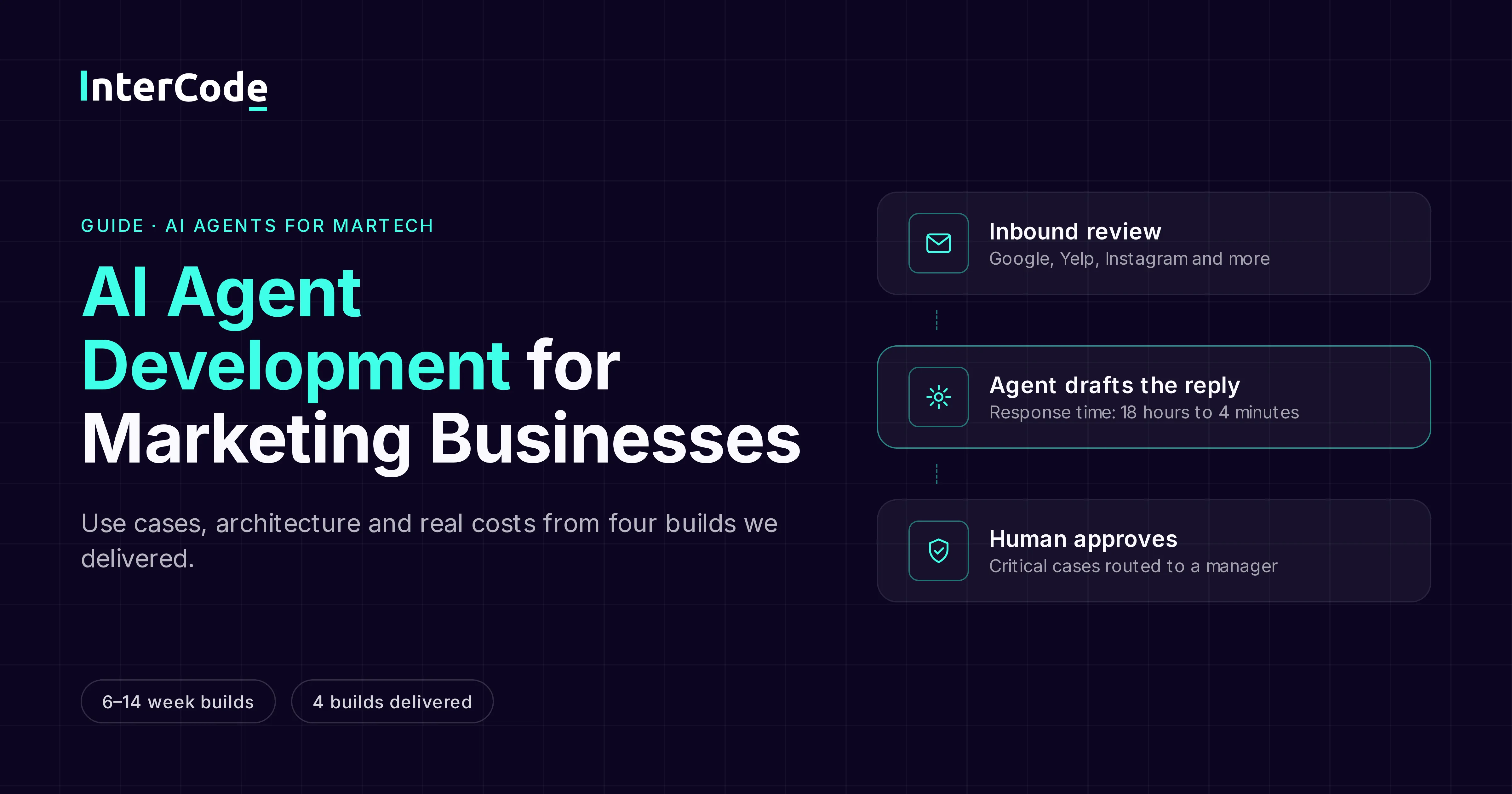
Localyser's review manager across 1,200 locations that cut response time from 18 hours to 4 minutes on a 6-week build.
Respage's leasing assistant that handles 62% of first-touch tenant enquiries without a human.
Street Digital's acquisition engine that cut manual prospect research by 73%.
This guide is for owners and CTOs of marketing businesses: agencies, martech platforms, and vertical SaaS. It covers AI agent development from the buyer's side:
What do these agents do?
How are they built?
What drives the cost?
What does an engagement look like?
Let's dive deep into this topic.
AI agent development for marketing businesses: what it means
An AI agent is software that:
Takes a goal
Decides which steps to take
Uses tools to take them
Hands off to a human when it should
If a chatbot answers, then an agent acts. It reads a review, checks the brand guidelines, drafts a reply, decides whether the review is critical, and routes it to the right manager.
In a marketing business, the useful agents sit inside the product you sell. Look at the four businesses we have built for.
| Client | What they sell | Who they serve |
| Street Digital | Multifamily digital marketing, with its own "Apartment Intelligence" software | Property owners |
| Respage | Multifamily lead generation and leasing platform | Property managers |
| Localyser | Reputation and guest-experience SaaS | Multi-location restaurant chains |
| Adway | Social recruitment advertising platform | 300+ global enterprises |
Every one of them delivers marketing or customer engagement to its own customers. In every case, the agent was built into that product, not bought as a subscription alongside it.
Custom AI agent development versus a subscription agent
| Buy a SaaS agent | Build a custom agent | |
| Where it lives | Beside your product | Inside your product |
| Whose data it runs on | The vendor's model and your export | Your own data, in your own stack |
| What your competitors can do | Buy the same tool tomorrow | Nothing. They cannot buy your feature |
| How it shows up to clients | A tool you resell or recommend | A feature of your platform |
Respage ships an AI Leasing Agent as part of its platform. Localyser's auto-reply is a Localyser feature. Neither is a tool a competitor can subscribe to. That is a product argument, and it is a commercial one too: a feature you own can be priced, improved and defended. A subscription cannot.
If one off-the-shelf tool already does the job and you are not reselling the capability, buy it. We say more on that in the section on when not to build.
7 AI agents for marketing products
Search for the types of AI agents and you get an academic list: reactive, deliberative, hybrid, and so on. It tells a marketing business owner nothing about what to build. Here are the 7 shapes that actually appear in marketing products, each with a live example.
| Shape | What it does | Live example |
| Response agent | Drafts on-brand replies, escalates what it should not answer | Localyser review auto-reply |
| Qualification agent | Scores and routes inbound leads, answers first-touch questions | Respage leasing assistant |
| Research agent | Gathers prospect or market context before a human acts | Street Digital acquisition engine |
| Creative adaptation agent | Reshapes one asset for each placement | Adway social job campaigns |
| Assembly agent | Builds a campaign from brief, audience and assets | BI and automation deployment |
| Insight agent | Turns performance data into a conversational answer | Localyser root-cause analysis |
| Orchestration layer | Decides which agent runs, and when a human is needed | Street Digital multi-agent system |
1. Response agent
It reads inbound messages, such as reviews, comments, and enquiries, and drafts replies that match the brand. Anything it should not answer, it escalates. The hard part is not the writing. It is knowing what not to write: a refund demand, a safety complaint or a legal threat should reach a person, not a template. Localyser's review auto-reply is the live example.
2. Qualification agent
It scores and routes inbound leads and answers first-touch questions when nobody is at a desk. Respage notes that most prospects reach out after 5 pm with simple questions, such as pet policy or tour scheduling. That is the work this agent takes, so the human team starts the next day with qualified conversations rather than a backlog of basic questions.
3. Research agent
It gathers and structures context about a prospect or market before a human acts on it. Street Digital's acquisition engine uses this shape to do the groundwork salespeople used to do by hand. The person still makes the call. The agent makes sure they start informed.
4. Creative adaptation agent
It reshapes one campaign asset for each placement and audience. Adway turns open roles and employer-brand content into social campaigns and adapts the creative to each placement, so one story does not have to be rebuilt by hand for every format.
5. Assembly agent
It builds a campaign from a brief, an audience, and a set of assets, then passes it to a human for approval. Our BI and automation deployment for a digital marketing agency, built with Anthropic's Claude, works this way.
6. Insight agent
It turns raw performance and feedback data into an answer someone can ask for in plain language. Localyser uses it for root-cause analysis across channels.
7. Orchestration layer
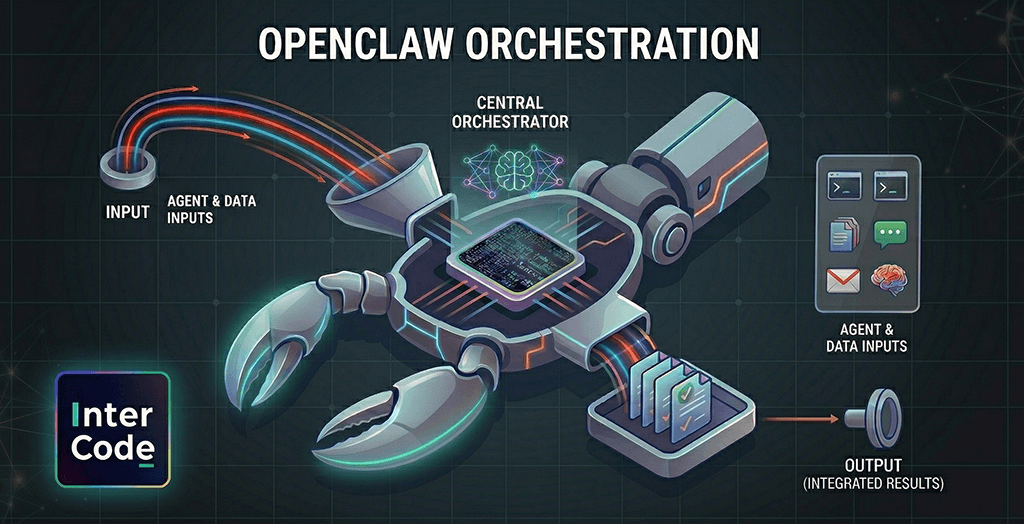
It decides which of the other agents runs, in what order, and when a human must step in. Street Digital's multi-agent architecture relies on one. A single agent can do one job well. An orchestration layer is what turns several of them into a product.
10 AI agents for marketing business use cases, by what you sell
We have organised AI for marketing agencies by what you sell, not by technology. Each names the agent shape it uses.
| # | Use case | Agent type | Description / Example |
| 1 | Review and reputation response at scale | Response agent | Localyser operates across 1,200 commercial locations, reducing average response time from 18 hours to 4 minutes. It analyses sentiment, writes personalised replies aligned with brand guidelines, and routes critical cases to the appropriate team. |
| 2 | First-touch lead qualification out of hours | Qualification agent | Respage's leasing assistant handles 62% of first-touch tenant enquiries without human involvement, including questions received outside office hours. |
| 3 | Prospect research before outbound | Research agent | Street Digital reduced manual prospect research workload by 73% and increased outbound outreach capacity by 3.2x without additional sales hires. |
| 4 | Campaign assembly from brief to draft | Assembly agent | In a BI and automation deployment, campaign creation time fell from 45 minutes to 10 minutes. |
| 5 | Creative adaptation per placement | Creative adaptation agent | Adway's platform adapts a single role or brand story for different social media placements. |
| 6 | Escalation routing to the right human | Orchestration layer | Localyser automatically routes critical escalations to regional managers. Defining the routing logic can require more work than implementing the model call itself. |
| 7 | Sentiment and root-cause analysis across channels | Insight agent | It analyses customer reviews to identify why ratings have dropped at a particular location. |
| 8 | Multi-channel inbox consolidation and triage | Response agent with orchestration | It consolidates messages from multiple channels into one queue and sorts them by urgency and the appropriate person or team. |
| 9 | Conversational reporting over campaign data | Insight agent | A BI deployment returns dashboards in under three seconds, allowing users to ask questions about campaign data instead of waiting for reports. |
| 10 | Renewal and retention outreach | Qualification and response agents | Identifies clients or tenants who may be at risk of leaving and drafts an initial outreach message for human review. |
How AI agents for marketing are built: architecture and integrations
You do not need to read code to judge an architecture. A marketing agent has five parts, and most of the difficulty sits in the parts that are not the AI model.
| Layer | What it does |
| Channel integrations | Pulls messages in and pushes replies out, one connection per channel |
| Agent layer with guardrails | Reads context, decides, drafts, and checks the draft against brand and policy rules |
| Human approval queue | Holds public-facing output until a person approves it |
| Escalation routing | Sends the cases the agent should not handle to the right human |
| Client data store | Keeps each tenant's data separate and under the client's control |
Integrations come first. For example, Localyser pulls Google, Yelp, TripAdvisor, UberEats, DoorDash, Instagram, Facebook, OpenTable, Talabat, Deliveroo and more into one inbox. Each channel has its own rate limits and approval rules, and each is a separate piece of work.
The human gate is part of the design. Anything the public will see needs an approval path, at least at first. That means queues, roles and an audit trail. Label it clearly in your own architecture, because it is also what lets you loosen supervision later, with evidence.
Multi-tenancy changes the build. A marketing business serves many clients, so one agent has to behave differently for each, with each tenant's data kept apart. That is a different build from a single internal agent.
AI agent development services: what it costs and what drives the number
The first question buyers ask is how much does it cost to develop an AI agent? For general price ranges, running costs and three-year total cost, see our AI agent development cost guide. This section covers what is specific to a marketing product.
| Driver | Why it moves the estimate |
| Channel integrations | Each channel is its own integration. Integration count, not model choice, is usually what moves the estimate |
| Brand voice fidelity | A correct reply that is off-brand is a defect here. Evaluating voice is real engineering time |
| Multi-tenancy | Per-client behaviour and data isolation |
| Human-in-the-loop approval | Queues, roles and an audit trail |
| Escalation routing | Often more work than the model call |
| Ownership of the output | If it goes into a product you sell, IP and data ownership must be settled up front |
Scope drove team size and timeline, and timeline drove cost:
Localyser took 6 weeks and a team of two and a half for one channel family and one decision.
Respage took 14 weeks and five people for a multi-tenant assistant wired into property management systems.
Street Digital saw over $320,000 in new enterprise pipeline within 5 months, an annualised ROI of more than 3.5x the capital cost. Localyser recouped its entire investment within 3 months.
What to expect from an AI agent development company: the engagement
When you hire an AI agent development company, you should know what happens at each stage and what you must supply. Ours has 4 stages and runs 6 to 14 weeks.
| Stage | What we do | What you supply |
| 1. Discovery and feasibility | Slice the workflow into tasks, test whether an agent can do them, and agree the metric | A written description of the workflow, a sample of real inbound data, and the one number this should move |
| 2. Architecture and data access | Design the integrations, tenancy and data model | Access to each channel and system, brand guidelines, and decisions on IP and data ownership |
| 3. Build with guardrails | Build the agent, brand-voice checks, approval queue and escalation routing | A named reviewer for outputs, and owners for each escalation path |
| 4. Validation and production | Test against real cases, run a supervised pilot, then scale | Pilot accounts, sign-off, and a decision on when the human gate can loosen |
The weakest engagements fail at stage 1, because nobody can describe the decision the agent is meant to make. We say so before any build begins. For how our own delivery process uses AI, see our guide to the AI software factory.
When not to build an AI agent for marketing business
An agent is not a strategy. It automates a decision you can already describe. If nobody in your business can write down the rule, the agent cannot learn it from nothing. So:
It needs volume to pay back. Localyser's payback came from an estimated 1,100 hours of monthly administrative triage across 1,200 locations. At 20 locations, the same build does not pay for itself.
Public-facing output needs a human gate. Do not plan to publish unreviewed agent output, at least at first.
Buy if one tool already does the job. If an off-the-shelf tool covers the need and you are not reselling the capability, subscribe to it.
Stabilise the workflow first. If your process changes every quarter, fix the process before you automate it.
Name the metric. If you cannot say what the agent should move, you are not ready for a scoping call.
AI agents for marketing must be weighted before developing to avoid wasting money and time.
Summary
For a marketing business, the case for AI agent development comes down to one choice: rent a capability your competitors can rent too, or build one into your own product, on your own data. Four businesses have made the second choice with us.
 18 likes