AI for Property Management: What It Does, What It Costs, and When to Build a Custom System
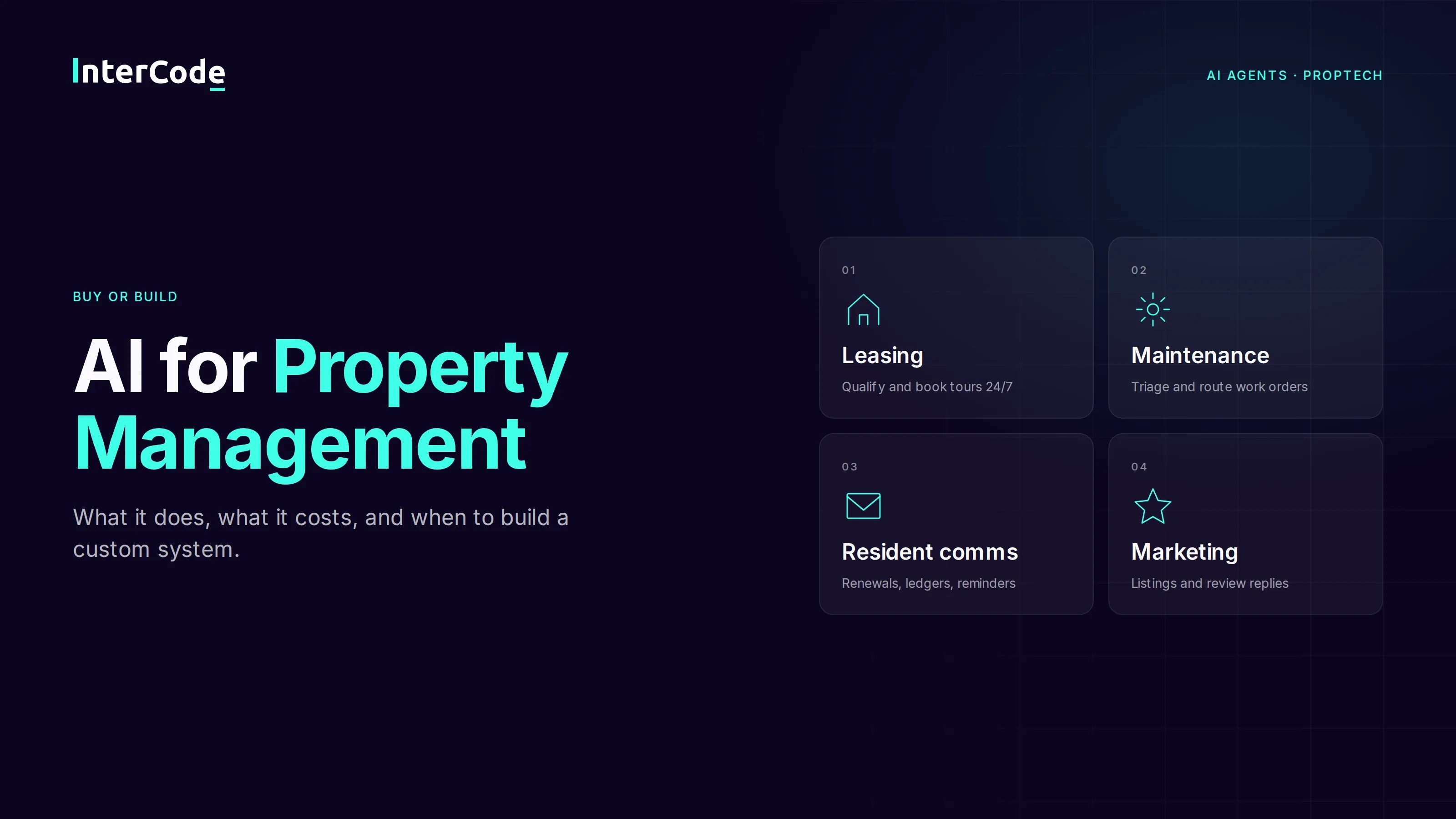
AI for property management now concentrates on 4 operational jobs: answering and qualifying leasing enquiries, triaging maintenance requests, handling resident communication, and marketing vacant units. Most property operators should buy an off-the-shelf tool rather than build software from scratch. Category leaders such as EliseAI, AppFolio Realm-X, and Showdigs cover standard operator workflows, with software typically priced per unit per month or quoted after a vendor demo. Building a custom system only makes financial sense at high portfolio scale or when the agent is part of a commercial software product sold to other operators.
The daily operational reality of AI for property management has shifted from theoretical experimentation to routine back-office and front-office execution. Capabilities that were speculative two years ago now run autonomously inside core property systems. Within the Yardi ecosystem, for example, operators already configure autonomous software agents that categorize vendor invoices, validate utility charges against historical baselines, and generate lease renewal offers without human intervention.
4 jobs AI does in property management
Across the property technology sector, vendor feature lists often bundle dozens of loosely related capabilities under a single banner. Actual market deployment has converged on exactly 4 core operational jobs: leasing, maintenance triage, resident communication, and vacant unit marketing and reputation management.
| Core Operational Job | Primary Workflows Covered | Category Leaders | Market Trajectory |
| Leasing | Answering out-of-hours enquiries, prospect qualification, tour scheduling, automated follow-up | EliseAI, Rently Ria, Showdigs, Respage AI Leasing Agent | Rapid expansion |
| Maintenance | Work order intake, diagnostic triage, vendor routing, emergency de-escalation | Happy Property, EliseAI | High adoption across multifamily and single-family |
| Resident Communication | Lease renewal notices, rent payment reminders, resident portal support, ledger queries | AppFolio Realm-X, Yardi Agents | Embedded directly into core PMS platforms |
| Marketing & Reputation | Vacant unit listing generation, outbound prospect campaigns, multi-location review response | Street Digital, SOCi Genius Reviews, Localyser mechanics | Consolidating around multi-agent outbound and review triage |
Answering and qualifying prospects with an AI leasing agent
The most commercially mature application in the industry is the AI leasing agent. Across multifamily communities and scattered-site portfolios alike, leasing teams lose qualified prospects because rental enquiries arrive when the traditional 9:00 AM to 5:00 PM leasing office is closed.
Operational data published by multifamily marketing platform Respage demonstrates that the majority of prospective tenants submit enquiries after 5:00 PM, creating a pronounced evening demand surge focused on straightforward qualifying questions regarding pet policies, parking availability, move-in fees, or tour scheduling. When a prospect waits until the next business morning for a reply, conversion rates drop sharply because the renter has already booked a showing at a competing property.
Respage AI Leasing Agent was engineered by InterCode over 14 weeks. Autonomous systems resolve 62% of first-touch tenant enquiries without a human while escalating the remaining 38% of complex or exception-based conversations to human leasing staff.
An AI leasing agent eliminates the after-hours response gap by operating across email, SMS text, web chat, and voice channels around the clock. Rather than following a rigid decision tree, modern agents connect directly to the property's real-time availability feed inside Yardi, RealPage, or AppFolio. When a prospect asks whether a two-bedroom unit allows large dogs and has an open tour slot on Saturday, the agent:
Checks unit-specific lease rules
Confirms live calendar availability
Answers the policy question
Pre-qualifies the prospect against income and credit thresholds
Books the tour directly into the leasing calendar
The agent then sends automated follow-up reminders to reduce no-show rates across the prospect journey.
Maintenance triage and work order routing
Maintenance coordination is the second largest labor sink in residential property operations. When a resident submits a maintenance request at midnight reporting water on the kitchen floor, a traditional answering service either wakes an on-call technician for a minor appliance drip or delays an urgent plumbing rupture until morning. AI maintenance triage systems sit at the point of work order intake. They:
Ask clarifying diagnostic questions
Prompt the resident to upload photos or short video clips
Classify the severity of the issue before a technician is ever dispatched
For non-emergency issues, the agent walks the resident through self-resolution steps, de-escalating tickets that would otherwise trigger a billable vendor trip. Examples of such non-emergency issues are tripped circuit breaker, a garbage disposal reset, or a thermostat battery replacement.
When a physical repair is required, the system generates a structured work order inside the PMS, matches the fault category to the operator's approved vendor list, checks contractor availability, and schedules the repair window with the resident automatically.
Resident communication and lease renewal automation
Between move-in and move-out, property teams spend thousands of hours answering repetitive administrative questions regarding ledger balances, utility bill-backs, parking passes, and lease renewal timelines. AI resident communication tools absorb this routine traffic inside the resident portal, SMS, and email. Because these assistants read directly from the resident ledger and lease document, they can explain a prorated water charge or confirm move-out notice requirements in seconds.
On the retention side, automated agents monitor upcoming lease expirations, generate renewal offer letters based on approved rent matrices, deliver sequential follow-up messages, and route signed renewal addenda back into the core PMS. By removing administrative friction from lease renewal and rent collection workflows, operators protect portfolio occupancy without expanding on-site headcount.
Vacant unit marketing and multi-location reputation management
The fourth job covers top-of-funnel demand generation and public brand protection. Generative marketing agents draft unit-specific listing descriptions tailored to individual floor plans, neighborhood amenities, and seasonal concessions, pushing updated copy to syndication portals whenever vacancy shifts. In enterprise leasing and property services, multi-agent systems also automate outbound prospect research and campaign execution.
Simultaneously, reputation management agents monitor incoming resident and guest reviews across Google, Apartments.com, and Yelp across hundreds or thousands of locations. It drafts context-aware responses within minutes and flagging systemic property complaints for regional managers.
AI property management tools and what each is built to do
Evaluating AI property management software requires separating full-suite PMS features from specialized third-party agents.
| Product | Primary Operational Job | Best Asset Class Fit | Architecture & Pricing Model | Editorial Assessment |
| EliseAI | End-to-end leasing lifecycle, maintenance triage, and delinquency collections | Mid-to-large Multifamily | Standalone multi-channel agent (email, text, voice); custom quote / per-unit | The category gold standard for institutional multifamily leasing |
| AppFolio Realm-X | Native resident communication, task automation, and message drafting | Multifamily & Single-Family on AppFolio | Native assistant embedded inside AppFolio PMS | Lowest-friction choice for teams already running AppFolio |
| Showdigs | AI-driven showing logistics and on-demand field agent coordination | Single-Family & Scattered-Site | Hybrid software + field network; per-unit / usage pricing | Purpose-built for dispersed rentals where on-site staff do not exist |
| Yardi Agents | Invoice categorization, utility validation, and lease renewal generation | Institutional Multifamily & Commercial | Native autonomous agents inside Yardi ecosystem | Strongest back-office accounting and renewal automation for Yardi users |
| Respage AI Leasing Agent | Out-of-hours prospect qualification, FAQ resolution, and tour scheduling | Multifamily Operators & Agencies | Built by InterCode for Respage (respage.com); bundled in platform | Handles 62% of first-touch tenant enquiries without human staff (Disclosure: InterCode client) |
| Rently "Ria" | Automated prospect response and self-guided tour coordination | Multifamily & Single-Family | Standalone AI leasing agent launched in 2026 | Strong fit for operators pairing AI chat with smart-lock self-showings |
| Funnel Leasing | Centralized leasing workflows and automated renter income verification | Large Multifamily Portfolios | Centralized CRM and leasing platform | Built for portfolio-wide centralized leasing teams rather than single sites |
| Happy Property | Maintenance workflow automation and resident repair intake | Multifamily & Scattered-Site | Specialized maintenance platform | Focused specifically on maintenance triage and inspection workflows |
| RealPage AI Screening | Automated tenant screening and applicant risk scoring | Institutional Multifamily | Native module within RealPage | Useful inside RealPage, though standalone AI screening searches are down 80% |
| TenantCloud | SMB property management with built-in AI assistant capabilities | Small Portfolios & Independent Landlords | Tiered flat/SMB subscription | Practical entry point for smaller portfolios that cannot justify enterprise tools |
| SOCi Genius Reviews | Multi-location review monitoring and automated response drafting | Multi-Site Multifamily & Commercial | Enterprise reputation management suite | Built for regional marketers managing reputation across dozens of properties |
| Convin | Contact-center call recording analysis and agent coaching | Centralized Leasing Call Centers | Conversation intelligence platform | Evaluates human and AI call quality rather than executing PMS workflows |
What early adopters report: vendor-published benchmarks
The following numbers illustrate where the financial return concentrates in large portfolios:
In student housing and large multifamily operations such as the Scion Group deployment, automating over 4,000 staff hours translates directly into more than $1 million in avoided call-center payroll.
At Summit Property Management, the financial impact spans 3 distinct revenue and cost lines simultaneously: lifting lead-to-lease conversion by 6%, de-escalating 34% of emergency maintenance calls before an after-hours vendor is dispatched, and recovering $3 million in delinquent rent through automated collections follow-up.
AppFolio's reported 26-second average message handling time and 10 hours of weekly administrative time savings demonstrate the immediate productivity lift of native PMS assistants.
While vendor case studies highlight best-case customer outcomes, they do not show what it costs or takes to engineer an independent system. You can get an understanding of pricing in our guide “How Much Does It Cost to Build an AI Agent? Real 2026 Pricing”.
AI for property management: team adoption and operational trust
The primary bottleneck is human adoption and operational trust. Even when a platform like Yardi provides autonomous agents capable of categorizing invoices, validating utility bills, and generating lease renewals without human touch, the system fails if on-site and back-office staff do not know how to supervise those tools. Or worse, actively distrust their outputs.
Treating staff onboarding as a single one-hour walkthrough during launch week does not survive the operational complexity of modern portfolios spanning multifamily, commercial, student housing, and senior living assets. Role-specific, continuous training is mission-critical across every department because each operational role interacts with automated agents differently:
If leasing consultants do not understand how the AI agent qualifies prospects or schedules self-guided and accompanied tours, they will override the calendar, double-book units, or send duplicate emails that confuse prospective renters.
In the back office, if accounts payable staff do not trust how an autonomous agent categorizes contractor invoices or flags utility charge anomalies, they will manually re-audit every line item, erasing the labor savings the software was bought to create.
If regional maintenance supervisors fail to adjust their dispatch rules to match automated diagnostic triage, technicians will ignore the AI's troubleshooting notes on work orders.
If property teams fail to introduce the new communication portal clearly, residents will bypass automated channels and continue calling the leasing office directly.
Successful operators treat workflow adoption and post-launch measurement as core project deliverables rather than afterthoughts. You must establish baseline metrics before launch and audit performance after month one.
When to build an AI property manager system instead of buying

A property management company operating 200 to 500 residential units will not beat EliseAI or AppFolio Realm-X on cost, speed, or reliability by hiring an engineering team to build a proprietary leasing chatbot. Off-the-shelf vendors amortize their research, voice-model tuning, and PMS maintenance costs across thousands of customer buildings. Building a custom AI property manager or leasing agent is the right commercial call only when all 3 of the structural conditions below hold true.
Condition 1: AI agent is part of a commercial product sold to customers
The clearest justification for building an AI leasing assistant is when the buyer is a proptech platform, marketing agency, or software vendor rather than a standalone property operator.
Respage illustrates this distinction directly. Respage is a multifamily leasing and marketing platform, and its AI Leasing Agent is a core product capability that Respage sells to its own property management clients.
A software company cannot build competitive enterprise equity by reselling a competitor's white-labeled chatbot. When the AI agent is a revenue-generating product feature that differentiates a platform in the market, owning the intellectual property, prompt orchestration, and unit economics is mandatory.
Condition 2: multi-tenancy and per-client data isolation requirements
Standard property management AI tools are designed for a single operator running its own portfolio. When a proptech platform, franchise network, or third-party management conglomerate serves dozens or hundreds of independent property management companies, the architectural requirements change completely.
A platform vendor requires strict multi-tenancy:
Per-client behavioral rules
Custom escalation paths per management company
Distinct brand voice guardrails per property owner
Cryptographic or logical per-client data isolation
Off-the-shelf tools sold to individual operators rarely expose the multi-tenant administrative APIs, tenant-level token metering, or granular permission layers required to operate as an embedded platform infrastructure.
Condition 3: portfolio volume sufficient to pay back the engineering investment
Even when a company has a custom workflow, the transaction volume must be high enough to amortize a five- or six-figure engineering build.
In InterCode's deployment for Localyser, the client achieved full financial payback within 3 months because the agent deflected approximately 1,100 hours of manual triage every month across 1,200 operating locations. Running that same engineering build across 20 locations would never generate enough labor savings to recover the development cost.
What building an AI agent looks like: 3 delivered projects by InterCode
| Client & Operational Focus | Vertical | Engineering Team Composition | Delivery Timeline | Delivered Build Cost | Measured Post-Rollout Outcome |
| Respage — Commercial AI Leasing Agent | Multifamily Leasing & Marketing Platform | 2 AI engineers, 1 full-stack developer, 1 MLOps engineer, 1 PM | 14 weeks | 140,000-275,000 | 62% of first-touch tenant enquiries handled without a human |
| Street Digital — Multi-Agent Customer Acquisition | Multifamily Digital Marketing ("Apartment Intelligence") | 2 AI developers, 1 backend engineer, 0.5 PM, 0.5 QA engineer | 10 weeks | $115,000 | Manual prospect research down 73%; outbound capacity up 3.2x with zero new hires; $320,000+ new enterprise pipeline in 5 months; >3.5x annualized ROI |
| Localyser — Multi-Location Reputation Agent | Hospitality & Guest Experience (1,200 locations) | 1 AI specialist, 1 backend engineer, 0.5 QA engineer | 6 weeks | $45,000 | Response time cut from 18 hours to 4 minutes (99.6% reduction); ~1,100 hours of monthly triage deflected; full payback within 3 months |
Where deployments go wrong and who should not build
Even well-funded property technology projects fail when leadership misjudges where the operational risk sits. 3 failure modes account for the vast majority of underperforming deployments of AI for property managers:
First, deploying autonomous agents without role-specific training causes immediate operational friction. When leasing staff distrust the tour calendar or accounting teams distrust automated invoice categorization in Yardi, employees build shadow spreadsheets and manual workarounds that defeat the software.
Second, every AI agent operates downstream of the property management system of record. If unit availability, concession rules, pet weight limits, or vendor call lists inside Yardi, RealPage, or AppFolio are outdated or split across unlinked spreadsheets, a conversational agent will deliver confident, grammatically polished, and factually wrong answers to prospects and residents. This means data hygiene inside the PMS must precede agent activation.
Third, Respage's finding that most prospects enquire after 5:00 PM explains both the commercial value and the operational hazard of leasing automation. After-hours is where an automated agent captures tours that would otherwise be lost. Still, it is also the window when no human manager is watching the console if the agent misinterprets a fair-housing question, quotes an expired rent concession, or fails to escalate an emergency water leak. Hard guardrails, deterministic fallback rules, and strict escalation triggers are mandatory before turning an agent loose on evening traffic.
By the way, we recommend you read our article “Operating the Autonomous Software Factory: Scaling Enterprise SDLC in 2027”.
Who should disqualify themselves from building
An honest assessment requires stating clearly who should not hire an engineering firm to build custom property management AI:
Operators whose functional needs are already met by an existing vendor tool and who have no plans to resell the software to other companies should buy an existing subscription rather than fund custom engineering.
Property management portfolios operating under a few hundred units do not generate sufficient inquiry or maintenance volume to amortize a $45,000 to $275,000 custom build within a reasonable payback window and should purchase an off-the-shelf tool instead.
Organizations that cannot name the specific operational metric the system must move are not yet ready to scope custom software or sign an enterprise vendor contract.
InterCode has all the needed expertise to develop AI agents for property management. We can consult with you on whether you need an AI assistant or not.
Conclusions
The commercial divide in AI for property management is now clear. Standard residential and commercial operators managing a few hundred or a few thousand units should invest heavily in role-specific staff training and take advantage of mature off-the-shelf software, selecting:
EliseAI for full-cycle multifamily leasing
AppFolio Realm-X or Yardi agents for native PMS automation
Showdigs for scattered-site portfolios
For proptech platforms, multifamily marketing agencies, and large-scale operators where the agent is a commercial product feature or requires multi-tenant data isolation across hundreds of client portfolios, off-the-shelf subscriptions hit an architectural and financial ceiling. Organizations scoping a proprietary build can evaluate InterCode's engineering approach.
 23 likes